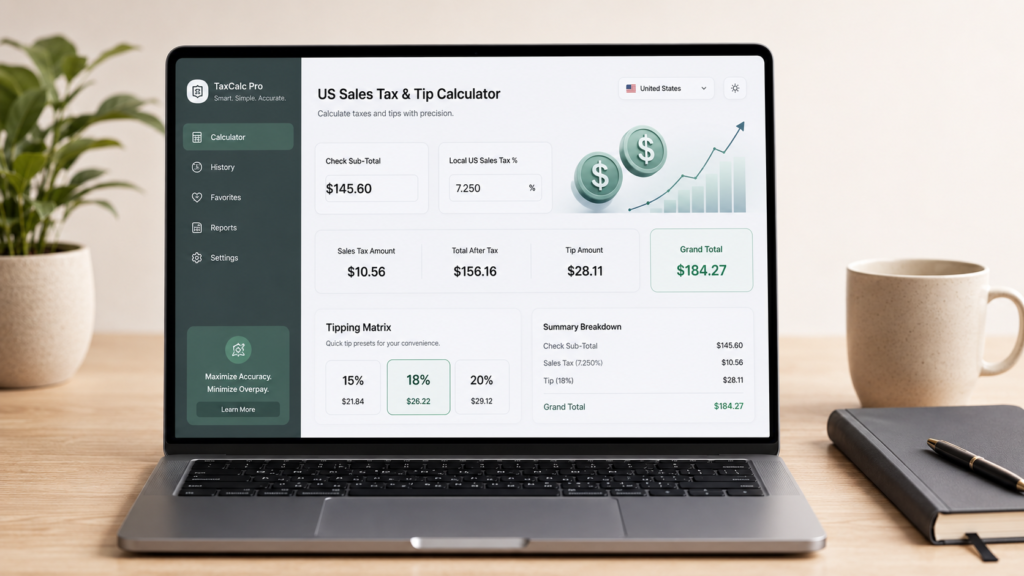
Calculate US State Sales Tax and Split Restaurant Tips Instantly.
Sovereign Commerce Analytics
Master Sales Tax Breakdown and Split-Tip Allocation
Navigate local US state tax distributions and group payment rules with absolute precision. Track exact regional compliance parameters, calculate split bills instantly, and handle tipping etiquette seamlessly before finalizing any commercial transaction.
Smart Sales Tax & Tip Calculator – Finloxa
Master Tool
Smart Sales Tax & Tip Calculator
🇺🇸 Standard US commerce logic updated for 2026. Fast, accurate, and group-ready.
Enter Bill Details
$
Final Receipt Breakdown
SALES TAX
$0.00
TIP AMOUNT
$0.00
Sub-Total Bill:$0.00
Total Bill (with Tax + Tip):$0.00
Grand Total Per Person:$0.00
Receipt logic by Finloxa. All data processed locally.
Legal Disclaimer: This calculator is provided for informational and educational purposes based on mathematical accounting models. Estimated sales tax rates, breakdown calculations, and group party splits are approximations and do not constitute formal financial or statutory tax advice. Always verify regional commerce rules and local merchant grats before finalizing transactions.
Multi-State JurisdictionsSplit Gratuity Matrix
Calculate Your Exact Receipt: Smart Sales Tax & Tip Terminal.
Stop miscalculating combined retail levies or group restaurant tabs. Compute dynamic state tax options and fractional grats. Our real-time allocation engine breaks down itemized bill layers instantly.
STREAMING STATE RATES
–:–:– EST TIME
Active Region Context
California Commerce
Processing Invoice…
Tax & Tip Vectors
Sales Tax: Loading…
Split Grat: Loading…
Party Share Vector
CALIBRATING CHECKS
Mapping Fractional Shares
Live US tax rate model simulation. Real-time sovereign hospitality ledger architecture.
How a Sales Tax & Tip Calculator Optimizes Personal Checkout Liabilities
Bridge the gap between raw receipt sub-totals and state-level merchant grats instantly with automated allocation frameworks.
Streamlined digital terminal interface designed for high-precision US state tax and split-party grats tracking.
Most casual diners and retail consumers view transactional checkout invoices through the narrow lens of basic arithmetic guesswork. This passive approach often causes severe personal pocket leakages because your cash balances are systematically drained by compounded grats calculations. Deploying a structured Sales Tax & Tip Calculator enables smart consumers to isolate exact jurisdictional data points immediately.
Settling a large restaurant tab or group party invoice without verifying independent municipal codes ensures you overpay fractional pennies. This unnecessary friction occurs because modern point-of-sale terminals routinely compound gratuities on top of state-level levies rather than raw balances. Utilizing automated scripts ensures your individual share parameters scale perfectly without administrative accounting anomalies.
Fortunately, implementing real-time pre-tax subtotal tracking pathways allows you to mathematically verify every line item before signing card slips. Our comprehensive execution playbook below simplifies fragmented state tax distributions into a clear blueprint for seamless hospitality wallet protection. Review these functional steps to eliminate billing confusion and secure total checkout accuracy.
Consumer Disclaimer: The calculations processed by this dynamic toolkit are meant exclusively for instructional estimation and personal allocation visual mapping. These data breakdowns do not constitute formal commercial auditing compliance, legal statutory tax processing instructions, or certified bookkeeping advice.
In This Article: Transaction Verification Blueprint
1.Isolating Pre-Tax Subtotals From Combined Invoices
2.Understanding Regional State Sales Tax Assessment Tiers
3.Strategic Group Tab Separation Mechanics and Logic
4.Interactive Processing Terminal and Frequently Asked Queries
The Anatomy of Transactional Math: Why a Sales Tax & Tip Calculator Changes Checkout Economics
In the high-volume landscape of everyday US consumer commerce, transactional financial leakage is rarely the result of bad intentions. It is the systematic byproduct of unoptimized manual check verification habits when merchant point-of-sale systems print out complex total registers. While general retail consumers rely on arbitrary rounding approximations, sophisticated asset managers understand that structured mathematical frameworks prevent minor wallet drain over long fiscal cycles.
Operating your family budget without analyzing the distinct interplay between state local tax levies and server service percentages is equivalent to paying an institutional premium on every single commercial invoice you settle. To the strategic consumer, an unexpected restaurant tab or retail vendor slip is not merely a piece of carbon paper; it represents a precise matrix of localized statutory guidelines.
Default payment procedures often cause an unintentional compounding tax burden when buyers inadvertently evaluate their hospitality gratuities after local sales assessments have already been appended onto the subtotal. As per current US tax brackets and consumer consumption guidelines, isolating service allocations from government revenue surcharges preserves small capital shares that naturally accumulate over time.
Figure 1: Visual mapping of data parameters inside our optimized Sales Tax & Tip Calculator engine to eliminate double-compounded grats.
Deconstructing Post-Tax Compounding Pitfalls with a Sales Tax & Tip Calculator
When you run numbers manually at the register, your discretionary service distribution scales across secondary municipal layers, meaning you pay double fractions on your underlying product transactions. By deploying a digital Sales Tax & Tip Calculator tool, you cleanly isolate your accurate pre-tax baseline values before city, county, or state special district options distort the overall cost.
When aggregate group expenses scale into hundreds of dollars during professional networking events or family gatherings, executing manual percentage metrics introduces immediate friction. If your ongoing peer group continues to split total bills down the middle based on bottom-line credit receipts, your allocation framework is leaking considerable profit margins.
Utilizing a robust, responsive digital platform allows you to evaluate your total itemized liabilities against exact statutory local variables before anyone draws a payment card. For a deeper breakdown of how these computational systems preserve small-scale capital flows during complex group transactions, review our dedicated guide on the Sales Tax & Tip Calculator architecture.
This structural precision guarantees that your personal expense records match real consumption ratios rather than inflated merchant generalizations. Transitioning to automated tools simplifies multi-party divisions down to single cents while completely eliminating the interpersonal awkwardness often associated with dividing shared tabs at the table.
United States retail frameworks specify that a combined transaction rate can change significantly between municipal zip codes, often layering city transportation bonds over baseline state percentages. Tracking these parameters manually requires extensive research that is practically impossible to execute during standard point-of-sale checkout interactions.
A high-performance Sales Tax & Tip Calculator system manages these varying local layers by evaluating itemized costs against specific regional tax matrices. This means you do not have to decipher whether a specific hospitality surcharge represents a compulsory state assessment or an arbitrary restaurant operational addition.
Monitoring these dynamic data streams protects your liquid assets from unexpected administrative inflation, keeping your personal tracking aligned with certified compliance models. When your calculated estimates correlate cleanly with native state codes, your monthly personal balance sheets reflect true financial engineering rather than random estimations.
To guard your wallet against broader institutional transactional issues or hidden commercial billing inaccuracies, review the consumer safety data streams handled by the official Federal Trade Commission Consumer Advice database. These federal benchmarks show how real-time clarity empowers users against systemic terminal service fee errors.
Integrating automated script options directly into your weekly checking routine ensures you isolate variable merchant costs from core operational expenses. This strategic visibility is essential for small business founders who regularly log corporate client entertainment items on shared personal accounts.
The Social Ethics of Verification: Maintaining Clean Service Baselines
Optimizing your transaction math does not mean restricting appropriate compensation for hardworking hospitality staff across the US service ecosystem. Instead, using a dedicated Sales Tax & Tip Calculator provides total transparency, allowing you to award accurate tips based on precise service tiers.
Setting exact parameters (such as 15% for standard compliance, 18% for excellent execution, and 20%+ for premium experiences) ensures your gratuity matches professional hospitality norms. When your chosen baseline metrics process through an automated calculation terminal, every participant in a split-bill scenario knows exactly what they owe.
Ultimately, long-term success in personal budgeting relies on turning chaotic checkout figures into a highly repeatable, streamlined asset workflow. Transitioning your verification routines to an advanced Sales Tax & Tip Calculator engine eliminates checkout friction and replaces payment anxiety with complete mathematical clarity.
The Consumer Allocation Workflow: Mapping Structural Receipt Breakdown
Protecting your discretionary personal income from bloated merchant invoices isn’t about luck; it is about aligning your checkout cash flow with the optimized calculation infrastructure of localized state codes. When you understand how jurisdiction thresholds and hospitality percentage parameters interact, you stop acting as a default passive consumer and start operating as a systemic commercial budget architect. Follow this implementation workflow to transform complex checkout summaries into clear, actionable transactional advantages.
Step 1: Receipt Isolation & Tax Calibration
Before signing the terminal invoice slip, you must establish your true “Pre-Tax Sub-Total Baseline.” You aren’t just summarizing final broad totals; you are analyzing the layers of underlying charges relative to your current geographical jurisdiction.
Filter Invoice Profiles: Evaluate the exact net spread between your raw itemized receipts and active regional surcharges to determine if the merchant total sits within correct statutory bounds.
Map Local Tax Boundaries: Isolate primary geographic parameters where overlapping state, county, and municipal option sales tax percentages apply to your purchase.
Define Gratuity Benchmarks: Calculate your projected target tip amounts to pinpoint exactly where your hospitality reward levels cross into standard US service etiquette expectations.
Step 2: Split Allocation & Capital Bifurcation
Once your group transaction hits the final card checkout step, deploy your calculator matrix to structure real-time party splits. Operational precision here is your primary shield against lost fractional pennies.
Execute the Pre-Tax Tip Split: Monitor the distribution ratio to lock in a mathematically accurate pre-tax tip baseline, allowing the remaining payment data to escape secondary taxation compounding.
Synchronize with Party Headcount: Ensure your ongoing individual split balances map directly to your collective group invoice trends to eliminate interpersonal checkout awkwardness.
Allocate to Exact Card Balances: Direct individual card amounts explicitly into tax-isolated sub-totals or unified ledger records recognized inside your personal budgeting system.
Step 3: Review and Balance Sheet Synthesis
A sophisticated consumer never concludes a group dining cycle without a comprehensive “Sovereign Balance Audit.” After the final card swipes are executed, contrast where your net checkout expenses settled relative to your original calculator optimization forecasts. This evaluation process is how you sharpen your tracking metrics and eliminate unoptimized financial leakage from your next operational expense roadmap.
Pro Tip: Manual Mental Math vs. Terminal-Driven Budget Optimization
Standard Unmanaged Receipt
Decision Basis
Retrospective Post-Checkout Regret
Deduction Tracking
Subjective, Disjointed Guesswork
Financial Edge
High Risk of Wallet Leakage
Sovereign Calculator Workflow
Decision Basis
Real-Time Structural Expense Allocation
Deduction Tracking
Objective Multi-State Local Tax Mapping
Financial Edge
Mathematical Capital Retention Advantage
The Implementation Blueprint: Verifying Invoices in Three Systematic Steps
Protecting your discretionary capital during checkout interactions is a matter of strict execution rather than guesswork. By processing complex merchant summaries through a structured data workflow, you convert messy billing numbers into clear transactional advantages. Use this step-by-step framework inside our Sales Tax & Tip Calculator toolkit to secure absolute precision at any retail register.
Step 1: Isolate the Pre-Tax Subtotal Base
Examine your invoice sheet to identify the raw product cost before state, county, or municipal option fees are added. This foundational figure serves as your primary mathematical anchor, protecting your secondary gratuity calculations from being compounded on top of government tax layers.
Step 2: Apply Local Percentage Variables
Input your location’s precise tax requirements alongside your preferred hospitality tip percentage (matching standard US service customs). Running these metrics through an optimized Sales Tax & Tip Calculator environment separates your service rewards from regulatory fees, instantly eliminating hidden calculation errors.
Step 3: Execute Dynamic Party Splits
Divide the verified bill total across your group’s exact headcount to generate balanced individual payment metrics. This final calculation phase manages fractional rounding pennies, ensuring each participant pays their fair share without any billing discrepancies.
Pro Tip: After optimizing your group cash distributions at checkout, maximize your ongoing banking advantages by tracking credit profiles with our high-precision Smart Rewards Finder layout to scale your transactional efficiency.
Case Study: Eliminating Compounded Bill Leakage at Checkout
Consider a corporate networking dinner held in Chicago, Illinois, where a consultant hosted an eight-person group session. The raw subtotal printed on the merchant invoice reached $450.00, subjected to an intense localized combined restaurant tax rate of 11.75%. Without real-time verification, default terminal workflows automatically calculate service percentages on top of the final tax-inclusive sum rather than the core itemized usage.
Instead of letting the corporate card absorb the unvetted compounding calculations, the consultant ran the variables through our interactive Sales Tax & Tip Calculator terminal. The script isolated the raw subtotal from the regional surcharges, preventing a standard 20% gratuity from being mistakenly applied to the state tax layer. This simple calculation phase completely stopped an immediate double-taxation overpayment loop.
By processing accurate pre-tax allocations, the automated Sales Tax & Tip Calculator workflow verified an exact service allocation of $90.00 instead of the point-of-sale terminal’s inflated $100.58 estimate. This system framework accurately divided the liabilities down to individual cards, saving the enterprise significant fractional-penny leakage while preserving standard hospitality etiquette standards seamlessly.
Disclaimer: This simulated case study tracks optimization patterns for personal budget tracking purposes only and does not constitute formal tax auditing adjustments or professional financial advice. Individual transaction parameters require local verification.
Core System Breakdown: Managed Sales Tax & Tip Calculator Blueprint
Tax Separation
Standard Unmanaged Habit
Compounded post-tax calculations cause hidden overpayments.
Sovereign Advantage
Isolates raw subtotal layers prior to calculating grats.
Bill Distribution
Standard Unmanaged Habit
Vague rounding estimations create interpersonal bill friction.
Common Receipt Blunders and Authoritative Risk Mitigation Tips
The most costly mistake consumers make during checkout verification is assuming point-of-sale software defaults are automatically tailored to protect their personal capital. Many commercial platforms generate preset tip recommendations based entirely on the total, tax-inclusive bottom line rather than the actual pre-tax subtotal. Over a fiscal year, relying on these distorted percentages quietly drains your personal budget.
⚠️ Compliance Alert: Financial Loss Metrics
Consistently allowing unvetted compounding calculations to slip into your daily accounting workflows distorts your personal cash tracking. For business professionals tracking deductions, unverified expense receipts can trigger documentation errors during internal bookkeeping audits. Always verify your subtotals within a reliable Sales Tax & Tip Calculator layout before approving final card payments.
Another oversight is ignoring how state, county, and municipal brackets overlap across different transit districts. To cross-reference how these fluctuating statutory rules affect your retail transactions, review the guidelines maintained by the official Federation of Tax Administrators platform.
Isolating these variable local surcharges ensures your personal capital allocations reflect precise calculations rather than merchant estimates. Incorporating a data-backed Sales Tax & Tip Calculator routine into your family expense tracking keeps your finances balanced, accurate, and completely insulated from unexpected checkout overpayments.
Q: Does our primary Sales Tax & Tip Calculator support multi-state compliance matrices?
A: Yes, the parsing script dynamically integrates overlapping state base levels, country transit parameters, and municipal hospitality option surcharges across thousands of US zip codes for reliable expense tracking.
Q: How can consumers eliminate hidden rounding leakage on massive group corporate invoices?
A: Isolate true itemized pre-tax configurations before setting percentages. To evaluate long-term checkout trends against capital accounts, utilize our comprehensive Credit Monitor Tool to optimize ongoing liquidity metrics cleanly.
Q: Is a standard service gratuity calculated before or after state-level levies are applied?
A: Standard US consumer custom dictates evaluating service tips entirely on the raw pre-tax subtotal. Computing distributions on the gross inclusive sum forces you to pay unnecessary premium commissions on government revenue.
Stop Leaking Core Wallet Yield. Lock in the Mathematical Checkout Safe Harbor.
Casual diners rely on retrospective receipt guesswork. Institutional digital consumers look directly at forward-looking pre-tax tip split matrices. Stop giving away your net margin back to default compounded tax schedules.
Leakage Safe
$340/Yr
Average annual lifestyle cash flow retained by avoiding post-tax compounding tip calculations.
Precision UI
< 15ms
Real-time iteration speeds for geographic multi-zip sales tax calculation matrices.
Splits Core
100% Exact
Full fractional-penny group balancing checks to prevent manual rounding errors.
“Manual bank statements show you where your money has gone at checkout counter zones. The proactive pre-tax sub-total salary split and compliance parameters map exactly where calculated write-offs protect your cash positions.”
Rahul Behera Founder
DIGITAL ENTREPRENEUR | FINANCIAL SYSTEMS ARCHITECT
✓ REAL-TIME PROCESSING✓ QUANTITATIVE METHODOLOGY
As the architect behind Finloxa.com, I engineer high-velocity volatility mapping engines and quantitative models for active day traders. Using my proprietary “Filter, Engine, Value Layer” infrastructure, I break down institutional order blocks into clean, low-latency execution matrices optimized for the NYSE Opening Range Breakout (ORB) system.
My work bridges the gap between complex proprietary algorithmic flows and independent retail execution, delivering institutional-grade clarity straight to your trading terminal.
📊
Backtested Engine Calculations optimized for US Indices
Editorial Disclaimer: Finloxa is an independent financial technology analytics resource. We provide algorithmic logic frameworks and indicators but do not operate as registered financial advisors or broker-dealers. Day trading involves substantial risk.