
2026 Federal Tax Calculator – Free US Tax Refund Estimator
Tax season always seems to creep up faster than expected, leaving many Americans scrambling to figure out what they actually owe or what kind of refund to look forward to. Whether you are balancing a W-2 salary, side hustling as an independent contractor, or trying to budget around deductions, guessing your numbers can cost you big time. That is why utilizing a dependable US federal tax calculator changes the game, giving you a clear look at your liability ahead of time so you can avoid unpleasant surprises come April.
The Withholding Guessing Game
Failing to check your paycheck withholding throughout the year often leads to a massive IRS bill out of nowhere, turning standard tax filing into an absolute headache.
Your Smart Planning Playbook
Take control of your annual finances early. By running your earnings through an accurate tool, you can map out your tax brackets, factor in standard deductions, and keep your hard-earned cash secure.
New to Estimating Your 2026 Taxes?
Getting an accurate estimate of your tax bill or refund doesn’t have to be complicated. If you’re unsure where to plug in your gross income, W-2 withholdings, or standard deductions, we’ve broken down the whole process into clear, simple actions. Need help filling out your tax details? Check out our easy 5-step calculator guide 📖 to quickly estimate your tax liability or refund in minutes.
Analyzing Your 2026 Federal Tax Horizon
1. Income & Filing Parameters
- Adjusted Gross Income (AGI): Your total earned wages, self-employment profits, interest, and dividends minus pre-tax payroll deductions.
- Filing Status Baseline: Institutional tax brackets shift significantly whether you file Single, Married Filing Jointly, or Head of Household.
2. Liability & Refund Diagnostics
- Deductions & Credits: Tracks the official IRS standard deduction versus itemized expenses along with child and clean energy tax credits.
- Withholding Balance: Compares total W-2 federal tax withheld across tax periods against your final net liability to estimate your tax refund.
The Dynamic Federal Tax Calculation Engine
Our taxation modeling engine processes marginal progressive tax brackets and inflation adjustments. The internal system resolves your estimated refund or tax balance due as follows:
Step 1: Determining Taxable Income Base
Your taxable income threshold is derived by applying the official IRS standard deduction or total itemized write-offs to your gross income:
Step 2: Calculating Final Net Refund or Owed Balance
After progressive tax rates are applied across your income brackets, tax credits and federal withholdings determine your bottom-line refund outcome:
Strategic Execution: Bridging the Optimization Deficit
If You Project a Tax Refund Surplus
Receiving a substantial tax refund means you have effectively provided the government with an interest-free loan throughout the year. Utilizing an accurate 2026 federal tax calculator enables you to adjust your W-4 payroll withholding allowances with your employer, placing more take-home cash directly into your bi-weekly paycheck to invest or pay down debt early.
If a Tax Underpayment Deficit is Detected
If your calculations flag an unexpected tax balance due, take immediate corrective steps to eliminate IRS underpayment penalties. Consider maximizing pre-tax traditional IRA or HSA contributions before the tax filing deadline. If you earn 1099 or freelance income, set aside estimated quarterly tax payments to avoid unexpected liabilities on tax day.
Federal Tax Strategy FAQs
How accurate is a dynamic US federal tax calculator for refund estimation?
An online US federal tax calculator provides a highly dependable estimate by processing the latest IRS tax brackets, standard deduction amounts, and federal withholding tables. For precise results, ensure you input accurate W-2 figures, self-employment income, and eligible tax deduction details.
What is the difference between tax deductions and tax credits?
Tax deductions reduce your overall taxable income before tax brackets are applied, lowering the amount subject to federal income tax. In contrast, tax credits offer dollar-for-dollar reductions directly off your final calculated tax liability, making them exceptionally powerful for increasing your tax refund.
How do pre-tax contributions lower my overall tax burden?
Contributions made directly to pre-tax workplace accounts—such as a traditional 401(k), 403(b), or Health Savings Account (HSA)—lower your reported Box 1 wages on your W-2 form. Lower taxable gross income effectively pushes portions of your income into lower federal tax brackets.
When will the IRS process my tax return and send my refund check?
The IRS issues over 90% of federal tax refunds within 21 calendar days when taxpayers file electronically and request direct deposit. Filing paper tax returns or claiming specific refundable credits (such as the Earned Income Tax Credit) can extend processing timeframes slightly.
US Federal Tax Calculator:
Estimate Your 2026 Federal Tax Refund Safely
Navigating IRS tax brackets across the United States requires absolute precision over your withholding records. This live optimization simulator models your federal tax liabilities, standard deductions, and projected refund thresholds in real time.
Continuous federal tax diagnostics. Factoring IRS Section 2026 inflation adjustments.
US Federal Tax Calculator:
How to Maximize Your 2026 Tax Refund Without IRS Penalties
Stop letting bad W-4 withholding selections or forgotten deductions lead to an unexpected tax bill when filing your 2026 federal returns with the IRS.
Introduction: Navigating Your Tax Liability via the US Federal Tax Calculator
Filing an annual return in Phoenix or planning quarterly withholdings in Houston requires absolute mastery over your IRS bracket obligations. Most American taxpayers approach tax season completely blind to how subtle W-4 adjustments and unexpected deduction shifts aggressively impact their net take-home pay and end-of-year refund sizes across active filing cycles.
They track aggregate earnings via surface-level payroll apps, celebrating a minor salary bump while completely ignoring the underlying marginal tax brackets that restrict prime-tier refunds before the IRS issues formal assessments. This reliance on fragmented withholding tracking creates an unsustainable operational bottleneck: without leveraging a consistent US Federal Tax Calculator, you submit your documents, only to discover your financial planning is completely locked down by unmitigated tax liabilities because your estimation framework fails to project real-time standard deductions and credit eligibility.
Key Takeaway / Quick Summary
A reliable US Federal Tax Calculator safeguards your financial standing by continuously projecting IRS bracket thresholds and potential refund amounts. By tracking filing statuses and deduction limits early, US taxpayers can systematically optimize their withholdings without incurring surprise tax bills.
To fully understand how statutory tax changes alter your household budget, evaluate these essential IRS compliance metrics:
- Filing Status Optimization: Choosing between Single, Married Filing Jointly, or Head of Household determines your precise standard deduction floor.
- Bracket Thresholds: Monitoring income limits prevents unintended spikes into higher marginal tax percentages.
- Credits and Adjustments: Factoring child tax credits and retirement account contributions directly lowers your overall adjusted gross income (AGI).
Real-World USA Example
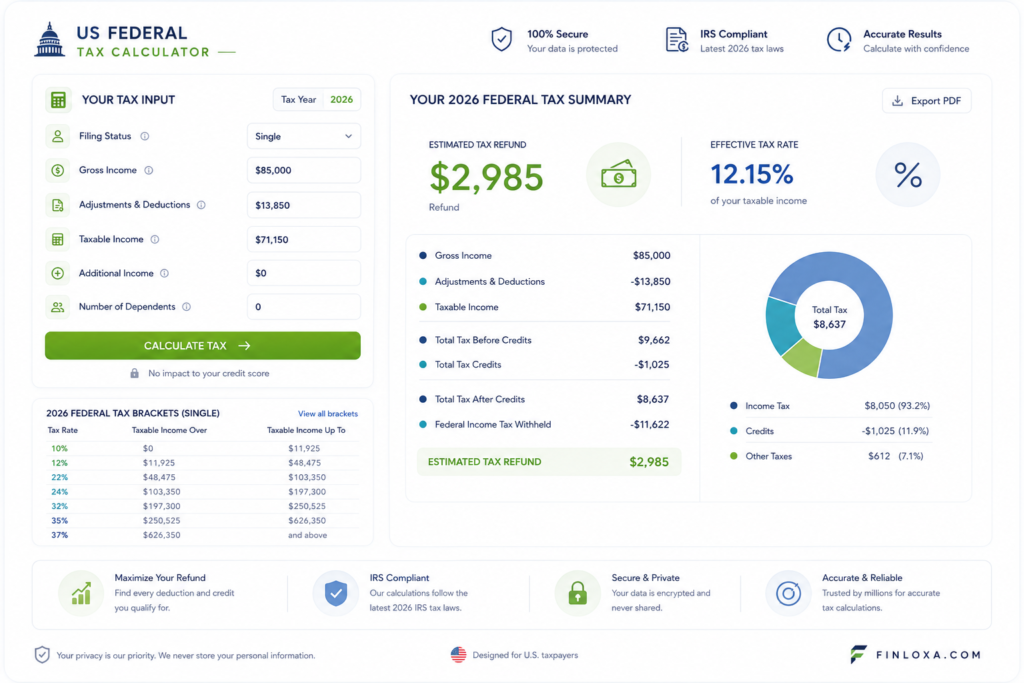
Consider a professional in Atlanta earning an annual salary of $85,000 under a single filing status. Utilizing a US Federal Tax Calculator highlights how standard deductions and payroll withholdings translate into an accurate estimation of your final tax liability before official IRS filing deadlines.
The definitive path to sustainable tax compliance requires an immediate systems upgrade. By running your income details through an active estimation matrix governed by a robust US Federal Tax Calculator, you secure the high-probability clarity needed to navigate complex IRS codes and secure absolute command over your annual financial returns.
Tax & Financial Disclaimer: The refund estimations, bracket tracking frameworks, and calculation tools provided on Finloxa.com are intended strictly for educational, strategic planning, and informational purposes. They do not constitute formal tax preparation services, certified CPA counseling, or guaranteed IRS refund amounts. Individual tax liabilities fluctuate based on legislative updates, deductions, and reporting accuracy; always verify critical tax parameters directly with certified public accountants or the Internal Revenue Service (IRS).


2026 Federal Tax Calculator – Free US Tax Refund Estimator
Step-by-Step Execution Guide
Planning your annual finances and anticipating tax season outcomes requires accurate forecasting under updated IRS tax brackets. Utilizing an intuitive US Federal Tax Calculator alongside a high-precision 2026 tax refund estimator empowers you to project total tax liability, optimize eligible deductions, and prevent unexpected end-of-year tax bills before filing.
Step 1: Preparation
Before entering numbers, compile your gross annual income statements, income tax withholdings, and current household tax filing status.
- Collect Primary Income Documents: Pull together your total wages from Form W-2 box 1, 1099-NEC earnings, dividend payouts, and interest statements.
- Confirm Filing Status: Select whether you are filing as Single, Married Filing Jointly, Married Filing Separately, or Head of Household to set correct standard deduction baselines.
- Track Total Federal Tax Paid: Input your cumulative federal income tax withheld to date from paystubs into the US Federal Tax Calculator to measure accurate refund potentials.
Step 2: Implementation
Run realistic tax scenario models using our digital 2026 tax refund estimator to apply above-the-line adjustments and valuable tax credits.
- Compare Standard vs. Itemized Deductions: Evaluate whether your combined state/local taxes (SALT), mortgage interest, and charitable gifts beat the inflated 2026 standard deduction.
- Apply Above-the-Line Write-offs: Subtract traditional IRA contributions, Health Savings Account (HSA) deposits, and student loan interest to lower your Adjusted Gross Income (AGI).
- Claim Key Tax Credits: Factor in high-value dollar-for-dollar tax reductions like the Child Tax Credit (CTC), Earned Income Tax Credit (EITC), and American Opportunity Credit.
Step 3: Review and Finalize
Review your net refund or balance due, make necessary W-4 adjustments with your employer, and lock in your tax strategy before filing.
- Adjust IRS W-4 Allowances: If your estimated refund is excessively high or shows a shortfall, update your employer W-4 form to adjust paycheck withholdings in real-time.
- Optimize Retirement Accounts: Max out eligible 401(k) or IRA deposits prior to deadline cutoff dates to squeeze extra savings out of your marginal tax bracket.
This federal tax calculation guide strictly adheres to official tax inflation adjustments published under Internal Revenue Code (IRC) guidelines and administrative updates issued by the Internal Revenue Service (IRS).
🛠️ Smart Tax Planning Tip: A massive refund means you gave the government an interest-free loan all year. Fine-tune your W-4 withholdings to get closer to a $0 balance at tax time, so you can keep more money in your monthly paychecks.