
Smart Tax Calculator 2026 – Federal & State Tax Estimator USA
Tax season can honestly feel like an absolute headache when you’re trying to figure out what you actually owe Uncle Sam. Whether you’re balancing a W-2 paycheck, bringing in freelance side-hustle money, or trying to avoid getting slapped with a surprise bill come April, guessing your numbers just doesn’t cut it anymore. That is why plugging your details into a dependable smart tax calculator changes the whole game, giving you a clear picture of your take-home pay, federal brackets, and deductions without any of the usual stress.
The Withholding Surprise
Underestimating your yearly tax liability or messing up your withholdings can lead to heavy penalties and an annoying call from the IRS, turning tax deadlines into a chaotic financial scramble.
Your Financial Planning Playbook
Take back control of your budget ahead of time. By relying on a trusted smart tax calculator, you can easily project your deductions, map out your yearly savings, and keep more cash right where it belongs—in your own bank account.
Smart Tax Calculator & Estimator 2026
Arizona State & Federal Tax Optimization Suite
Filing Status
Employment & Wealth Income
Retirement & Savings
$0
$0
$0
$0
💡 AI Optimization Advisor
Maximize your pre-tax 401(k) and HSA contributions to lower your taxable bracket.
Analyzing Your 2026 Tax Exposure Horizon
1. Income Inputs & Filing Status
- Adjusted Gross Income (AGI): Includes W-2 wages, self-employment income, business profits, and taxable investment dividends.
- Filing Classification: Dictates your baseline federal tax brackets—whether Single, Married Filing Jointly, or Head of Household.
2. Deductions & Jurisdictions
- Standard vs. Itemized: Automatically weighs the updated 2026 IRS standard deduction against qualified mortgage interest and charitable gifts.
- State & Local Taxes (SALT): Factor in state income tax rates across all 50 US states to calculate your true net take-home pay.
The Dynamic Tax Calculation Engine
Our 2026 federal and state tax estimator computes your liabilities using progressive marginal tax brackets rather than flat taxation. The core algorithm executes in two systematic phases:
Step 1: Determining Taxable Income
First, the engine isolates your taxable exposure after subtracting pre-tax contributions and baseline deductions:
Step 2: Total Tax Liability & Net Take-Home Calculation
Next, federal marginal brackets, FICA (Social Security & Medicare), and state tax schedules are applied to determine final liability:
Strategic Execution: Bridging the Optimization Deficit
If Your Tax Exposure is Balanced
If your effective tax rate aligns with your financial goals, you are in a prime position to build long-term wealth. Maintain this trajectory by optimizing your pre-tax retirement contributions (401k/403b) and Health Savings Accounts (HSA). Your main task is keeping track of tax law updates so future income raises don't quietly push you into a higher federal marginal bracket.
If a Tax Optimization Deficit is Detected
If your calculated tax drag is higher than expected, you need an active tax mitigation strategy. Run different income scenarios using a high-precision free tax calculator 2026 to see where you can save. Consider maxing out Traditional IRA options, exploring tax-loss harvesting in taxable brokerage accounts, or restructuring self-employment income through S-Corp distribution strategies.
2026 Tax Strategy & Estimator FAQs
How accurate is this tax estimation model for 2026 tax returns?
This tool factors in the official IRS federal inflation adjustments, baseline 2026 bracket schedules, FICA thresholds, and state-level income tax rates. Using an advanced US income tax calculator gives you a clear and realistic projection of your federal and state tax obligation before filing season begins.
What is the difference between Marginal Tax Rate and Effective Tax Rate?
Your marginal tax rate is the highest bracket applied to your top dollar of income. Your effective tax rate is the actual overall percentage of your total income paid to the government. Because US taxes are progressive, your effective rate is almost always lower than your marginal rate.
How do pre-tax deductions lower my total tax burden?
Contributions made to Traditional 401(k) accounts, 403(b) plans, HSAs, and FSAs are subtracted directly from your gross earnings before taxes are computed. This lowers your overall Adjusted Gross Income (AGI), reducing both federal and state tax obligations instantly.
Does this calculator handle state income taxes for states with no tax?
Yes. If you reside in states like Texas, Florida, Washington, Nevada, Alaska, Wyoming, or South Dakota, the state tax variable automatically sets to 0%. The calculator will focus exclusively on computing your federal taxes, FICA obligations, and applicable tax credits.
Smart Tax Calculator:
Federal & State Tax Estimator for USA Filers
Figuring out your annual IRS liabilities across multiple income streams and state tax brackets can be overwhelming for American workers. This live tax simulator tracks federal thresholds, standard deductions, and withholding metrics in real time to prevent surprise bills.
Continuous federal & state liability calculations. Factoring IRS guidelines and standard deduction parameters.
Smart Tax Calculator:
How to Estimate Federal & State Taxes Accurately
Stop stressing over unexpected tax bills and confusing IRS deductions when April rolls around by accurately projecting your federal and state obligations in advance.
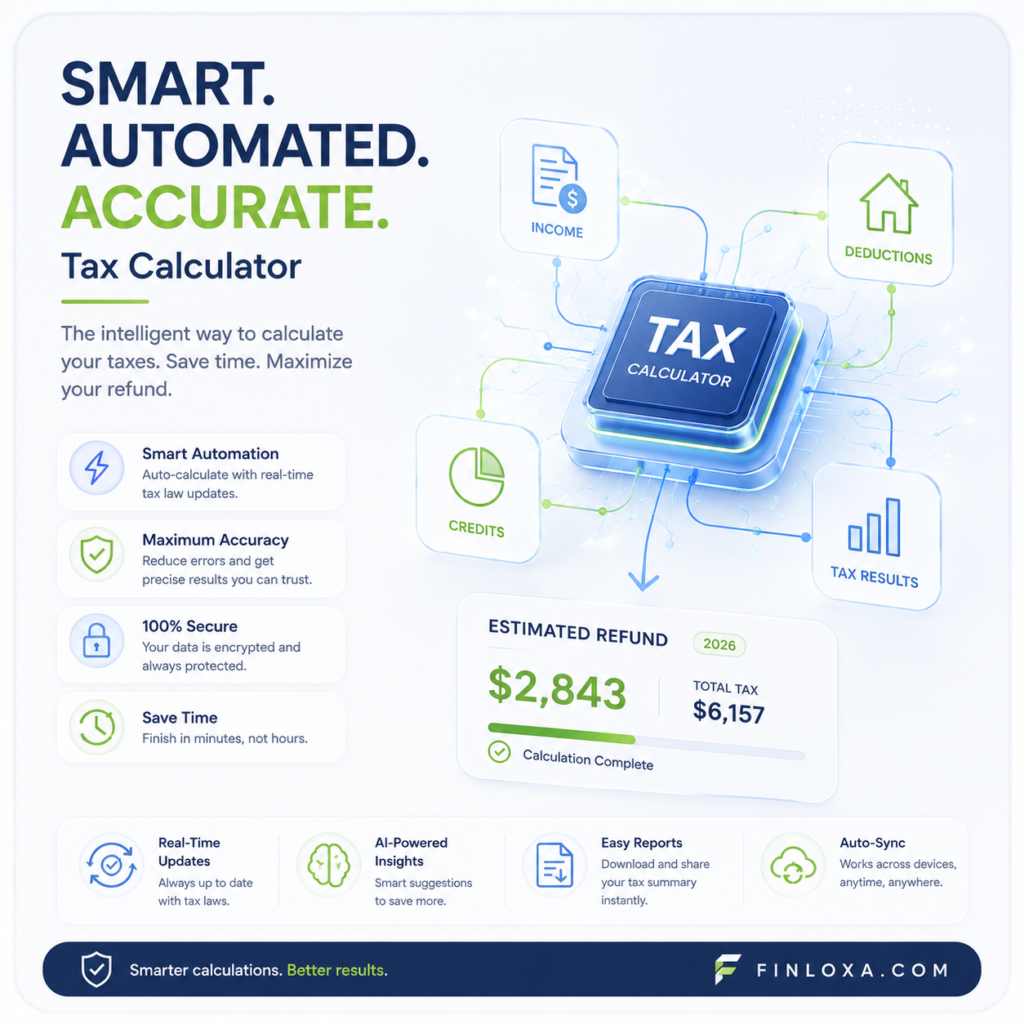
Introduction: Maximizing Your Take-Home Pay via the Smart Tax Calculator
Submitting an accurate annual return in Texas or optimizing W-4 withholdings in New York requires absolute mastery over your federal and state tax liabilities. Most American taxpayers approach filing season completely blind to how subtle shifts in deductions, multi-state residency changes, and marginal bracket adjustments aggressively impact their net household income across active fiscal cycles.
They rely on generalized paycheck estimators or static software tables, celebrating a rough gross income figure while completely ignoring underlying deductions and credits that restrict maximum refund potential before the IRS issues formal assessments. This reliance on fragmented tax tracking creates an unsustainable operational bottleneck: without leveraging a consistent Smart Tax Calculator, you submit your Form 1040, only to discover your refund is heavily reduced or subject to surprise underpayment penalties because your estimation framework fails to account for shifting tax brackets in real time.
Core Benefits of Precision Tax Forecasting:
- Accurate Federal Bracket Alignment: Instantly map your household income across IRS marginal tax tiers to prevent unexpected tax bills.
- State-Specific Deduction Tracking: Evaluate state tax nuances across zero-income-tax states like Florida versus high-tax jurisdictions like California.
- Deduction Optimization: Compare standard deductions against itemized write-offs including mortgage interest and charitable contributions.
Key Takeaway / Quick Summary
A reliable Smart Tax Calculator safeguards your financial standing by continuously analyzing federal guidelines, FICA withholdings, and state-specific tax obligations. By catching calculation errors and projecting liability early, US taxpayers can systematically optimize their net cash flow without incurring surprise IRS penalties.
The definitive path to sustainable fiscal optimization requires an immediate systems upgrade. By running your household income through an active estimation matrix governed by a robust Smart Tax Calculator, you secure the high-probability clarity needed to navigate complex IRS code requirements and secure absolute command over your annual tax strategy.
Tax & Financial Disclaimer: The estimations, tax bracket projections, and financial modeling tools provided on Finloxa.com are intended strictly for educational, strategic planning, and informational purposes. They do not constitute formal tax advice, certified CPA services, or guaranteed IRS filing approvals. Individual tax liabilities fluctuate based on legislative changes, filing statuses, and specialized deductions; always verify critical tax parameters directly with certified public accountants or the Internal Revenue Service (IRS).


Smart Tax Calculator 2026 – Federal & State Tax Estimator USA
Step-by-Step Execution Guide
Navigating federal income brackets alongside varying state tax rates requires real-time precision and forward planning. Utilizing an intuitive Smart Tax Calculator alongside an updated US tax estimator 2026 allows you to forecast annual liabilities, optimize filing status selections, and uncover key deductions before tax season arrives.

Step 1: Preparation
Before calculating your net obligations, gather all relevant income documentation and determine your optimal filing category under IRS guidelines.
- Collect Gross Earnings: Aggregate W-2 wages, 1099 contractor earnings, investment dividends, and side-hustle revenue sources into one total.
- Select Filing Status: Choose whether Single, Married Filing Jointly, Married Filing Separately, or Head of Household yields maximum standard deductions.
- Factor in State Locality: Check if your state collects progressive income tax, flat rates, or zero personal state tax (like Texas or Florida).
Step 2: Implementation
Run realistic simulation models using our online Smart Tax Calculator to apply above-the-line deductions and eligible tax credits.
- Lower Adjusted Gross Income (AGI): Input pre-tax contributions toward traditional 401(k) accounts, Health Savings Accounts (HSAs), and Traditional IRAs.
- Compare Standard vs. Itemized Deductions: Determine if mortgage interest, state and local tax limits (SALT), and charitable gifts beat the updated 2026 standard deduction amount.
- Apply Direct Tax Credits: Factor in high-value dollar-for-dollar credits like the Child Tax Credit (CTC) or energy-efficiency home upgrade credits.
Step 3: Review and Finalize
Finalize your figures using a reliable US tax estimator 2026 module to compare withholdings against estimated liabilities before tax deadlines.
- Compare Payroll Withholdings: Cross-check year-to-date federal and state tax withholdings listed on your latest pay stubs against projected liabilities.
- Adjust Form W-4 Early: Modify allowances or extra paycheck withholdings if your calculations predict an unwanted tax bill or an excessively large refund.
This execution guide strictly complies with tax policy parameters released by the Internal Revenue Service (IRS) and individual State Departments of Revenue for the 2026 tax year.
🛠️ Smart Tax Strategy: Maximize pre-tax 401(k) and HSA contributions before the end of the calendar year to drop your marginal tax bracket and keep more of your hard-earned income.