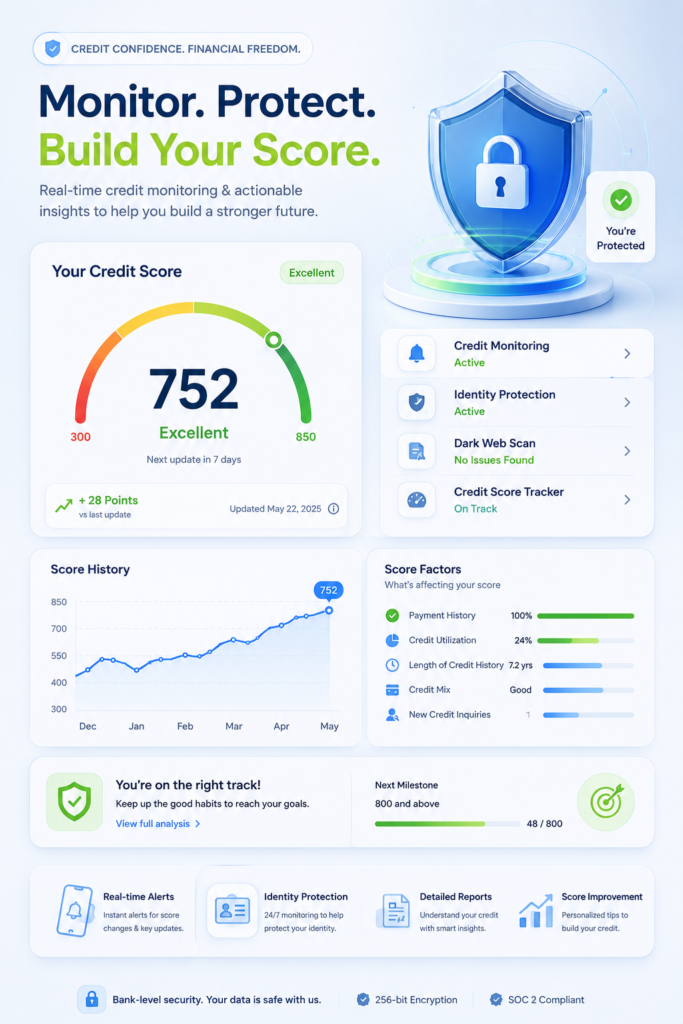
Free Credit Score Monitor & Estimator 2026 – USA Tools
Let’s face it—staying on top of your financial health across the States can feel like a full-time gig. Whether you’re gearing up to buy your first house, shopping around for a reliable auto loan, or just trying to lock down a better APR on your rewards card, you’ve got to know where you stand.
That’s precisely why having a dependable credit score monitor in your corner makes all the difference, letting you stay ahead of unexpected drops and keep your borrowing power intact.
Catching Credit Surprises Early
A random reporting error from a major bureau or a sudden jump in your credit utilization can quietly wreck your score overnight—costing you thousands down the road if you don’t catch it right away.
Your Smart Tracking Routine
Taking charge of your credit doesn’t have to be a headache. By building a simple habit around a trusted credit score monitor, you can easily review your standing, prep for big milestones, and move forward with total peace of mind.
Mortgage Calculator & US Home Loan Estimator | Finloxa
US Mortgage Calculator
Accurate PITI estimation conforming to US lending guidelines (FHA, Conventional, & Conforming Limits)
Estimated Monthly Payment (PITI)
$2,850/mo
Principal & Interest
$2,275
Property Tax (Est. 1.1%)
$412
Homeowners Insurance
$131
Mortgage Insurance (PMI/MIP)
$0
✨ Tip: Outstanding strategy! A 20% down payment helps you avoid paying Private Mortgage Insurance (PMI) in the US.
Analyzing Your Credit Horizon
1. Core Score Factors
Payment History Impact: Tracks on-time mortgage, card, and auto loan payments across Experian, Equifax, and TransUnion.
Credit Utilization Ratio: Evaluates your revolving debt balance relative to total available limits—aiming strictly below 30%.
2. Projection Diagnostics
Hard Inquiry Cushion: Simulates how applying for new credit cards or loans impacts your score over a 12-month window.
Debt Payoff Acceleration: Models the exact point boost you gain by paying down revolving high-interest credit lines.
The Dynamic Gap Modeling Math
This credit estimation layer models point shifts using standardized FICO 8 and VantageScore 4.0 algorithms. The internal logic processes credit profile trajectories as follows:
Step 1: Quantifying Aggregate Credit Utilization
The exact ratio of total revolving debt compared directly against your combined card limits:
The simulator calculates projected point gains based on planned balance reductions and account aging milestones over time:
Projected Score = Current Score + (Payoff Factor × Point Weight) – (Inquiry Penalty)
Strategic Execution: Bridging the Optimization Deficit
If Your Projected Score Meets Prime Benchmarks
You are ideally positioned to lock in the lowest prevailing interest rates on US conventional mortgages, auto refinancing, or premium rewards cards. Focus on maintaining a zero-balance strategy across minor credit cards and keeping utilization under 10% right before your monthly statement closing dates to lock in tier-one borrowing power.
If a Score Deficit is Detected
If your score falls short of loan approval thresholds, utilize our free credit estimator USA interactive tool to run targeted recovery scenarios. Prioritize paying down high-utilization cards first, request credit limit increases without hard pulls, dispute credit bureau errors, or consider becoming an authorized user to quickly close the point gap.
Credit Score Strategy FAQs
How often should I check my credit report?
Using an automated credit score monitor lets you track monthly balance updates, new inquiries, and score changes safely without hurting your score. Under US federal law, you are also entitled to free weekly official reports from AnnualCreditReport.com across all three major credit bureaus.
Will using an online estimator lower my credit score?
No. Estimators and consumer monitoring tools conduct a soft inquiry (or soft pull), which is completely invisible to lenders and has zero negative impact on your FICO or VantageScore ratings.
What is the fastest way to boost my score in 30 days?
Paying down revolving card balances to get your total utilization under 10% yields the fastest result. You can also dispute incorrect negative marks directly with Equifax, Experian, or TransUnion to have inaccurate late payments or collections removed promptly.
What is the difference between FICO 8 and VantageScore 4.0?
FICO 8 is the industry standard used by over 90% of top US mortgage and auto lenders, placing heavy weight on payment history and debt levels. VantageScore 4.0 is widely used by free monitoring apps and considers trended credit behavior over time, giving earlier credit-building credit to consumers with shorter credit histories.
USA Credit DefenseBureau Audit Engine
Master Your Credit Score Monitor: Track FICO and VantageScore Metrics Safely
Keeping your borrowing power strong across the United States requires active supervision of your consumer report data. This live optimization simulator tracks credit bureau updates, debt-to-income limits, and revolving utilization thresholds in real time.
Credit Score Monitor: How to Protect Your FICO Standing Across US Bureaus
Stop letting silent credit reporting mistakes or unexpected utilization spikes quietly damage your borrowing power when applying for American mortgages, auto loans, or rewards credit cards.
Track and protect your credit health with our secure credit monitor.Free Credit Score Monitor & Estimator 2026
Introduction: Navigating Your Credit Health via the Free Credit Score Monitor
Securing a mortgage in Austin or locking down a prime auto loan in Chicago requires absolute mastery over your revolving credit profile. Most American consumers approach financial milestones completely blind to how subtle reporting shifts and unexpected credit bureau fluctuations aggressively impact their borrowing power and everyday interest rates across active lending cycles.
They track aggregate scores via surface-level banking apps, celebrating a minor upward tick while completely ignoring the underlying debt utilization ratios that restrict prime-tier lending access before lenders issue formal rejections. This reliance on fragmented credit tracking creates an unsustainable operational bottleneck: without leveraging a consistent Free Credit Monitor, you apply for a major credit card or housing lease, only to discover your approval engine is completely locked down by unmitigated credit report errors because your monitoring framework fails to flag sudden reporting discrepancies in real time.
Key Takeaway / Quick Summary
A reliable Free Credit Monitor safeguards your financial standing by continuously tracking Equifax, Experian, and TransUnion data. By catching reporting errors and tracking debt-to-income fluctuations early, US consumers can systematically boost their approval odds for top-tier loans without incurring surprise subscription fees.
The definitive path to sustainable credit optimization requires an immediate systems upgrade. By running your profile through an active monitoring matrix governed by a robust Free Credit Monitor, you secure the high-probability clarity needed to navigate complex bureau score models and secure absolute command over your borrowing potential.
Credit & Financial Disclaimer: The score estimations, bureau tracking frameworks, and monitoring tools provided on Finloxa.com are intended strictly for educational, strategic planning, and informational purposes. They do not constitute formal financial counseling, certified credit repair services, or guaranteed lending approvals. Individual credit scores fluctuate based on reporting changes, payment histories, and utilization rates; always verify critical lending parameters directly with certified financial institutions.
Why Active Credit Tracking Controls American Financial Freedom in 2026
Navigating the complex landscape of American personal finance requires continuous oversight over your credit profile. Whether you are planning to secure a competitive home mortgage, lower your auto insurance premiums, or apply for high-reward financial products, your 3-digit score dictates your borrowing power. Operating without a real-time credit score monitor leaves your entire credit file vulnerable to sudden score drops, unauthorized reporting errors, and identity theft risks.
In the current U.S. economic framework, many consumers mistakenly believe that checking their own profile costs money or lowers their rating. In reality, utilizing a soft-inquiry tracking utility helps maintain your rating without hurting your file. By leveraging a reliable free credit estimator USA tool, consumers can project how debt payoff plans, credit limit adjustments, or new loan applications will alter their overall rating before taking real-world financial action.
To maintain optimal financial positioning, every American consumer must align their borrowing strategies with real-time bureau feeds. Understanding the difference between raw credit reports and predictive algorithms gives you the strategic leverage needed to dispute inaccuracies, keep credit utilization below 30%, and unlock top-tier interest rates across major lending institutions.
Official Federal Guidance: Under federal law enforced by the Consumer Financial Protection Bureau (CFPB), consumers have the legal right to inspect their credit records and monitor their financial files to ensure data accuracy across major credit reporting agencies.
Strategy 1: Active Monitoring Protocols & Utilization Control
The foundational step toward optimizing your personal balance sheet requires separating static annual reports from dynamic monitoring. Traditional reporting offers a snapshot of your past accounts, but an automated tracking platform observes live balance updates, credit line inquiries, and delinquency alerts as they hit Equifax, Experian, and TransUnion.
Your revolving credit utilization ratio represents roughly 30% of your total score calculation. When revolving balances breach 30% of your maximum credit limits, scoring algorithms penalize your profile, signaling elevated credit risk to prospective lenders. Combining regular checking with an automated system allows you to pay down card balances prior to monthly statement closing dates, ensuring low reported utilization figures.
Direct Action Plan: Establish weekly soft-inquiry tracking across all three primary credit bureaus. Set automated alert thresholds for revolving card utilization above 10% and immediately file formal disputes with the credit reporting agency if unexpected accounts or unauthorized hard inquiries appear on your profile.
Strategy 2: Simulating Financial Moves Before Applying
Taking major financial leaps without running predictive models often leads to costly surprises. Whether closing an older credit card account or taking on a consolidation loan, every credit action causes algorithmic ripple effects. Utilizing a dedicated free credit estimator USA utility allows consumers to test complex scenarios risk-free before submitting actual credit applications.
For instance, when preparing to apply for a prime auto loan or mortgage, running a digital simulation reveals whether paying down $3,000 in credit card debt will elevate your rating into the 740+ prime tier. These predictive tools calculate variables such as average age of accounts, credit mix, and payment history weights to provide realistic scoring projections.
💡 Professional Credit Optimization Tip:
Never close your oldest zero-annual-fee credit cards when trying to boost your rating. Closing legacy credit accounts shrinks your total available limit and reduces your average age of accounts, which can cause an immediate drop in your score. Always use a simulator to check the score impact before closing any open credit line.
Strategy 3: Eliminating Bureau Inaccuracies and Protecting Rating Integrity
Even a pristine payment record can be compromised by clerical mistakes or fraudulent activity. According to financial regulatory studies, millions of American credit files contain errors ranging from misreported late payments to duplicate collection accounts. A continuous tracking framework ensures that inaccurate negative marks are detected early before doing long-term damage.
By combining real-time bureau alerts with a dedicated credit score monitor, you can instantly flag unauthorized hard inquiries, unexpected address updates, or unfamiliar credit accounts. Rapid detection allows you to initiate formal FCRA disputes with credit bureaus and freeze your credit files when identity theft threats arise.
Evaluation Metric
Automated Real-Time Tracking
Passive Annual Checking
Fraud & Error Detection Speed
Instant alerts upon reporting changes, inquiry spikes, or balance shifts.
Delayed. Mistakes remain uncorrected for up to 12 months, dragging down score potential.
Predictive Planning Edge
Uses interactive estimation tools to forecast loan approval odds.
None. Relies on guessing outcomes after hard inquiries hit your credit report.
Mastering your credit profile is an ongoing financial habit rather than a one-time event. By deploying continuous proactive oversight alongside predictive planning tools, you position yourself to maintain top-tier prime credit ratings, protect your assets from fraud, and minimize borrowing costs across every stage of your life.
Taking control of your US financial health requires real-time tracking and precise planning. Using a reliable Credit Score Monitor alongside a high-precision free credit estimator USA allows you to forecast credit score changes, spot errors early, and optimize your overall lending profile before applying for major loans or credit cards.
01
Initial Assessment
Step 1: Preparation
Before tweaking your financial profile, collect your foundational data from the three major US credit bureaus (Equifax, Experian, and TransUnion).
Pull Your Base Reports: Obtain your updated credit profiles from annualcreditreport.com to review your current debt levels.
Identify Benchmark Numbers: Record your base FICO and VantageScore metrics inside your active Credit Score Monitor interface.
Isolate High-Impact Inquiries: Highlight recent hard pulls and check your total credit utilization percentage across all revolving accounts.
02
Action & Simulation
Step 2: Implementation
Apply strategic changes to your accounts and run simulations using an online free credit estimator USA to test financial outcomes before taking real-world action.
Simulate Target Scenarios: Plug potential actions—like paying off a $3,000 credit card balance or opening a new auto loan—into the estimation tool to see your projected score jump.
Automate Monthly Payments: Set up auto-pay for all active credit accounts to keep payment history at 100% flawless.
Lower Revolving Balances: Strategically reduce total balance ratios below 10% to capture maximum points in scoring models.
03
Optimization & Lock
Step 3: Review and Finalize
Lock in your updated progress, clear lingering discrepancies, and maintain long-term stability across all reporting platforms.
Dispute Reporting Errors: File official disputes directly with bureau portals if outdated negative items remain past statutory timelines.
Enable Real-Time Alerts: Configure SMS and email push notifications inside your software to get immediate alerts for new hard inquiries or balance changes.
🛡️ Regulatory & Editorial Trust Verification
✓ Fact-Checked & Reviewed
This execution guide strictly complies with US credit reporting guidelines under the Fair Credit Reporting Act (FCRA) and guidance issued by the Consumer Financial Protection Bureau (CFPB).
Primary Reference
FCRA (15 U.S.C. § 1681)
Ensures consumer rights to fair, accurate, and private credit reporting.
Bureau Data Standard
Equifax / Experian / TransUnion
Calculated via official FICO® Score 8 and VantageScore® 3.0 models.
Consumer Protection
CFPB Monitoring Guidelines
Mandates free annual reports and direct dispute resolution protocols.
🔒
Data Integrity Notice: Soft credit pulls and estimation tools used during score monitoring do not impact your credit score or trigger hard inquiries on your report.
🛠️ Financial Growth Tip:
Monitoring your credit profile regularly prevents unexpected surprises during major mortgage or loan applications. Make sure to audit your reports quarterly to keep your score in top tier health.
Strategic Credit Advantage
Evaluate how our Free Credit Score Monitor & Estimator 2026 empowers your financial future compared to traditional credit tracking methods.
✓
Pros & Benefits
✓Real-time Soft Inquiries: Track your score anytime with zero impact on your credit history.
✓What-If Scenario Modeling: Simulate mortgage, auto loan, or card applications before pulling the trigger.
✓Instant Identity Alerts: Catch fraudulent accounts early with automated US bureau monitoring.
✓Actionable Score Boosters: Receive customized strategies to optimize credit utilization and payment timing.
✕
Cons & Alternatives
✕Standard Annual Reports: Traditional free annual checks lack dynamic monthly updates and alerts.
✕Paid Bureau Services: Traditional credit monitoring packages charge high recurring subscription fees.
✕Hard Pull Risks: Checking scores through formal lender applications temporarily lowers your rating.
✕Static Score Statements: Basic banking apps display numbers without explaining how to fix dips.
🔒 100% Client-Side Engine
Private & Real-Time Financial Modeling
Your financial data stays completely private. All estimations run locally inside your browser using real-time institutional formulas, with zero server logging or personal data tracking. Test different scenario parameters freely to structure your long-term wealth trajectory with complete peace of mind.
Frequently Asked Questions
Will checking my rating with a Credit Score Monitor hurt my score?
+
Not at all. Utilizing an active Credit Score Monitor alongside our estimation tool triggers a soft inquiry on your profile. Soft inquiries never impact your official FICO or VantageScore credit ratings, allowing you to run calculations and simulate future scenarios as often as you like with complete peace of mind.
How accurate are these estimated calculations for US consumers?
+
Our algorithm reflects updated 2026 scoring standards used across major US bureaus like Experian, TransUnion, and Equifax. While individual lenders weigh proprietary factors, our estimates align closely with standard VantageScore 3.0 frameworks to give you a clear, realistic financial roadmap.
How quickly can paying off balance debt boost my score?
+
Most credit card issuers report account balances to bureaus monthly at the close of your billing cycle. Once your credit utilization ratio drops below 30% (or ideally under 10%), you can typically expect to see visible rating improvements within 30 to 45 days.
Final Takeaway: Take Control of Your Financial Future
Building an exceptional financial profile isn’t about guessing game decisions—it comes down to consistent, informed habits. By relying on a dependable Credit Score Monitor, tracking your utilization rates, maintaining flawless payment histories, and testing payoff strategies beforehand, you position yourself for lower interest rates and seamless loan approvals in 2026. Keep auditing your reports monthly, adjust your strategy as your budget evolves, and let smart planning unlock your path to true financial independence.
Rahul Behera
Founder
DIGITAL ENTREPRENEUR | FINANCIAL SYSTEMS ARCHITECT
✓ 2026 US Tax Compliant
✓ Data-Driven Methodology
As the architect behind Finloxa.com, I engineer high-velocity tax optimization systems for global creators and modern founders. Using my proprietary “Filter, Engine, Value Layer” methodology, I break down complex IRS code structures into actionable, clean pipelines aligned with 2026 US tax guidelines.
My work bridges the gap between complex federal requirements and the needs of digital entrepreneurs, ensuring absolute financial clarity.
🔍
Fact-CheckedData aligned with official IRS sources
🔒
EncryptedEnterprise-grade data protection
⚖️
TransparentIndependent resource hub
🎓
Expert-LedArchitecture for modern wealth
Editorial Disclaimer: Finloxa is an independent financial technology resource. We provide data-driven insights but do not operate as a licensed CPA or legal entity. Consult a certified professional for specific tax filings.