
W2 vs 1099 Calculator 2026 – Which is Better for You?
Deciding between a traditional salaried role and the freedom of independent contracting isn’t just about comparing raw hourly rates. A $100,000 contractor offer might sound way better than an $85,000 salary on paper, but once self-employment taxes, health insurance, and missing benefits kick in, the real take-home pay can be surprising. Using a reliable W2 vs 1099 calculator helps you break down exact tax obligations, value hiddden employee perks, and figure out which path actually puts more cash in your bank account.
The Hidden Contractor Trap
As a 1099 contractor, you are on the hook for the full 15.3% self-employment tax (covering both employer and employee portions of FICA). Without employer-funded 401(k) matching, paid time off, or group insurance, a higher gross paycheck can quickly shrink if you don’t calculate your true overhead costs early on.
Your Net Compensation Playbook
Know your worth before signing any offer letter or contract. Running the numbers through a targeted W2 vs 1099 calculator allows you to factor in Schedule C write-offs, state tax variations, and benefit valuations so you can negotiate higher contract rates or lock in the security of a W-2 salary with complete confidence.
Bridge Fund Architect
Micro-accurate temporary capital planning for high-growth real estate & business transitions.
Scenario Metrics
Exit Strategy Cost Modeling
🚀 Protect Assets Before Structuring Transitional Debt
US underwriting systems heavily penalize structural ambiguity. Launching a compliant corporate layer isolates personal liability during heavy transitions.
Format Entity with ZenBusiness →Analyzing Your Compensation Horizon
1. Core Pay Mechanics
- W-2 Salaried Stability: Your employer automatically covers half of your FICA taxes (7.65%), offers subsidized health benefits, 401(k) matching, and paid time off.
- 1099 Contractor Rate: You earn a higher hourly or contract rate, but you assume responsibility for the full 15.3% Self-Employment Tax alongside your own benefits.
2. Tax & Deductions Diagnostics
- Business Expense Shield: 1099 workers can write off eligible home office costs, mileage, equipment, and software, offsetting taxable gross income.
- The Equivalent Rate Marker: Pinpoints the exact 1099 pay rate required to match your current W-2 total compensation package cleanly.
The Dynamic Tax Comparison Math
Evaluating a job offer or a freelance pivot requires stripping away gross numbers to analyze net take-home cash. Our engine processes federal, state, and payroll tax logic as follows:
Step 1: Calculating 1099 Self-Employment Tax Exposure
Contractors are responsible for both employee and employer portions of Social Security and Medicare taxes calculated on net business profit:
Step 2: Factoring Qualified Business Income (QBI) & Benefits Offset
Eligible 1099 earners can deduct up to 20% of qualified business income before income tax brackets apply, balancing out missing employer-paid benefits:
Strategic Execution: Bridging the Optimization Deficit
If the W-2 Option Yields Higher Value
When employer contributions to health insurance, 401(k) matches, and paid leave exceed the potential upside of freelance rates, staying W-2 offers clear advantages. Enjoy predictable paychecks, automatic tax withholding, paid time off, and lower individual administrative overhead.
If a 1099 Rate Gap Needs Optimization
If you are considering leaving full-time employment, run our interactive W2 vs 1099 calculator to establish your target hourly baseline. To make switching worthwhile, aim for a contractor rate at least 25% to 35% higher than your current W-2 wage to comfortably cover self-employment taxes, private health insurance, and personal retirement funding.
Bridge Fund Strategy FAQs
How does the employee vs contractor tax liability differ in 2026?
Understanding employee vs contractor tax rules comes down to who pays the payroll tax bill. Employees only pay 7.65% for FICA while their employer matches the other 7.65%. Independent contractors must pay the entire 15.3% self-employment tax, though they can deduct half of that payment on their federal tax return along with legitimate business expenses.
What rule of thumb should I use to convert a W-2 salary to a 1099 hourly rate?
A trusted industry standard is taking your annual W-2 salary, dividing it by 2,000 work hours, and adding a 30% markup. For example, an $80,000 W-2 salary translates to an hourly base of $40. Adding a 30% premium brings your target 1099 hourly rate to roughly $52 to match net take-home and cover missing employer benefits.
Can 1099 contractors still utilize the Qualified Business Income (QBI) deduction?
Yes, eligible pass-through entities and sole proprietors can deduct up to 20% of their net qualified business income, subject to IRS income thresholds and industry limitations. This tax advantage helps offset the additional self-employment tax burden when transitioning from a W-2 role.
How should independent contractors manage estimated quarterly taxes?
Because clients do not withhold taxes from your checks, you must pay estimated taxes to the IRS and state tax authorities quarterly (April, June, September, and January). Setting aside 25% to 30% of every invoice into a separate tax savings account ensures you avoid underpayment penalties at tax time.
W2 vs 1099 Calculator 2026:
Compare Net Income & Self-Employment Tax Realities
Deciding between a corporate W-2 salary and freelance 1099 contracting in the US involves more than just comparing base pay figures. This live calculator simulator evaluates payroll withholdings, FICA obligations, and business deductions across federal tax brackets.
Continuous employment tax comparative modeling. Factoring IRS Schedule C write-offs and self-employment tax rules.
W2 vs 1099 Calculator:
How to Choose the Right Path for Your Income & Taxes
Stop guessing whether a higher-paying freelance gig will actually put more money in your pocket after factoring in self-employment taxes, health insurance costs, and lost corporate benefits.
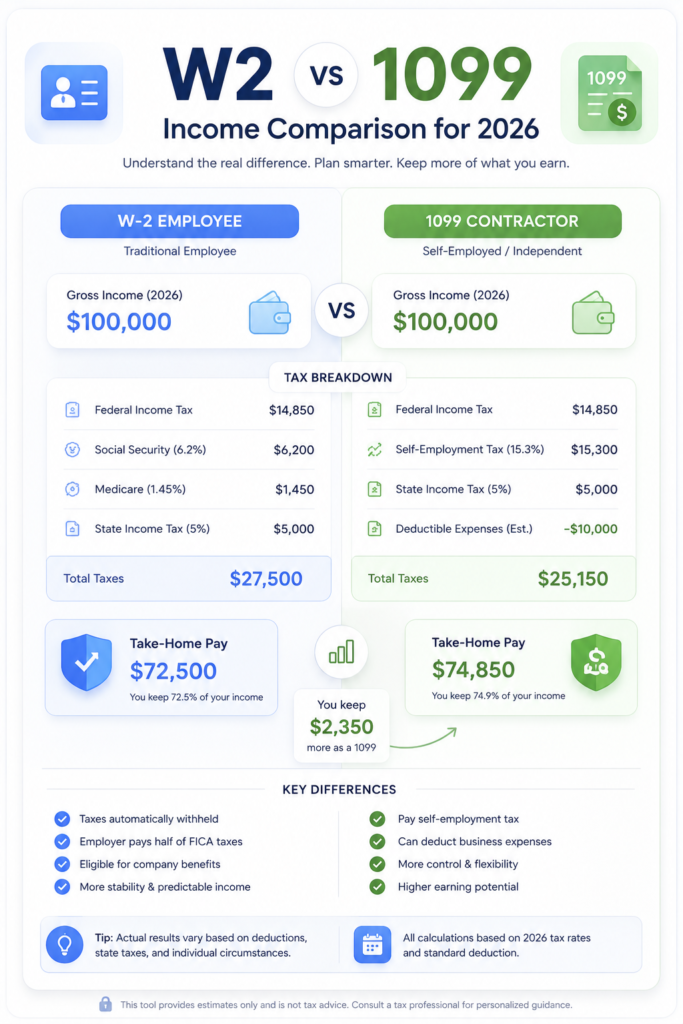
Introduction: Evaluating Your Earning Potential with the W2 vs 1099 Calculator
Transitioning from a traditional corporate job in New York to independent consulting in Dallas demands absolute clarity over your net take-home pay. Most American independent contractors and full-time employees approach career shifts completely blind to how self-employment taxes, healthcare deductions, and employer-sponsored benefits aggressively alter their true annual earnings across active tax cycles.
They evaluate job offers solely based on gross base salary, celebrating a higher hourly independent rate while completely ignoring the double-sided FICA taxes and missing paid time off that quietly erode profit margins. This reliance on surface-level math creates a severe financial blind spot: without leveraging a dedicated W2 vs 1099 Calculator, you accept a lucrative independent contract, only to discover your quarterly tax liabilities completely wipe out your projected savings because your initial financial planning failed to account for real-world business expenses.
Key Factors Measured by the Tool:
- Self-Employment Tax Burdens: Accounting for the full 15.3% Social Security and Medicare contribution borne entirely by 1099 contractors versus the split employer match for W2 workers.
- Fringe Benefits & Paid Leave: Calculating the monetary value of health insurance premiums, 401(k) matching, paid sick leave, and PTO lost during independent transitions.
- Deduction Optimization: Factoring in Schedule C business write-offs, home office deductions, and software tools that lower taxable contractor revenue.
Key Takeaway / Quick Summary
An accurate W2 vs 1099 Calculator safeguards your annual income by contrasting employee benefits against independent contractor tax obligations. By projecting net earnings early, American professionals can systematically optimize their career choices without falling victim to unexpected IRS tax bills.
The definitive path to strategic career planning requires an immediate analytical upgrade. By running your job offers through a structured comparison matrix governed by a robust W2 vs 1099 Calculator, you secure the high-probability financial clarity needed to navigate tax structures and secure absolute command over your professional income.
Tax & Financial Disclaimer: The earnings projections, tax estimations, and financial tools provided on Finloxa.com are intended strictly for educational, strategic planning, and informational purposes. They do not constitute formal certified public accounting (CPA) advice, legal counsel, or guaranteed tax savings. Individual tax liabilities fluctuate based on federal guidelines, state regulations, and personal deductions; always verify critical tax parameters directly with certified financial professionals or the IRS.


W2 vs 1099 Calculator 2026 – Which is Better for You?
Step-by-Step Execution Guide
Deciding between taking a traditional full-time role or stepping into independent contracting directly impacts your take-home pay and tax obligation. Running your offer through a high-precision W2 vs 1099 calculator helps you evaluate true take-home pay by factoring in self-employment taxes, health benefits, retirement matches, and write-offs before signing your next work agreement.

Step 1: Preparation
Before running numbers, gather your base salary or hourly rate offers to accurately compare key worker classifications under IRS regulations.
- Gather Compensation Data: Note down your base annual W-2 salary offer alongside competing 1099 contract hourly or project rates.
- Account for Employer FICA: Remember that W-2 employers split Social Security and Medicare taxes (7.65%), whereas 1099 contractors cover the full 15.3% self-employment tax.
- Evaluate Employee vs Contractor Tax Nuances: Understanding the fundamental employee vs contractor tax structure ensures you don’t underestimate federal, state, and payroll withholdings.
Step 2: Implementation
Run realistic scenario models using an online W2 vs 1099 calculator to factor in business expense write-offs and out-of-pocket health insurance costs.
- Input Tax Write-offs: List eligible 1099 business deductions, including home office space, internet, professional software, and equipment expenses.
- Value W-2 Benefits: Quantify health insurance subsidies, paid time off (PTO), 401(k) employer matching, and disability insurance provided in W-2 roles.
- Apply QBI Deduction: Factor in the 20% Qualified Business Income (QBI) tax deduction available to eligible 1099 sole proprietors and LLC owners.
Step 3: Review and Finalize
Compare true net income, set aside quarterly estimated taxes for 1099 path, or lock in stable paychecks under a W-2 setup.
- Calculate Required Contract Premium: Ensure your 1099 hourly rate is at least 25% to 30% higher than an equivalent W-2 salary rate to cover self-employment costs.
- Plan Estimated Tax Payments: If choosing the 1099 path, set up automated quarterly tax payments to avoid IRS underpayment penalties.
This evaluation guide complies with statutory guidance from the Internal Revenue Service (IRS) and the U.S. Department of Labor (DOL) regarding worker misclassification and self-employment tax liabilities.
🛠️ Smart Negotiation Tip: When transitioning from a W-2 job to 1099 consulting, aim for a contractor rate that is 1.3x to 1.5x your hourly base salary to account for self-funded health coverage, paid time off, and self-employment taxes.