
LLC Tax Savings Calculator 2026 – Save on Business Taxes USA
Running a small business or startup here in the US comes with plenty of rewards, but tax season can easily eat right into your hard-earned profits if you aren’t paying attention. Whether you’re operating as a single-member LLC or weighing an S-corp election, figuring out your true liability shouldn’t feel like guesswork. That is why plugging your numbers into a dependable LLC tax calculator makes all the difference, helping you plan ahead for self-employment taxes, spot smart write-offs, and keep more cash in your business bank account.
The Self-Employment Tax Trap
Many founders get blindsided by federal income and self-employment taxes come April, losing thousands of dollars simply because they didn’t map out their quarterly estimated payments ahead of time.
Your Smart Deduction Playbook
Take control of your bottom line. By using a trusted LLC tax calculator to forecast your net earnings and write-offs, you can streamline your yearly budgeting and avoid any painful surprises with the IRS.
LLC vs. S-Corp Tax Savings Calculator
ESTIMATE YOUR 2026 FICA & SELF-EMPLOYMENT TAX SAVINGS WITH AN S-ELECTION
IRS Calculation Details
Analyzing Your LLC Tax Horizon
1. Core Financial Inputs
- Net Business Income: Your total annual LLC earnings after subtracting all legitimate business expenses and operational overhead.
- Reasonable W-2 Salary: The reasonable compensation paid to yourself under S-Corp election rules, based on industry standards.
2. Taxation Diagnostics
- Self-Employment Tax Shield: Highlights how electing S-Corp status caps your 15.3% FICA liability strictly to your salaried wage.
- Retained Profit Distributions: Identifies pass-through profit draws that avoid self-employment taxes entirely while remaining subject to income tax.
The Dynamic Tax Savings Math
Our calculation engine dynamically evaluates federal self-employment obligations versus optimized corporate election strategies. The math flows as follows:
Step 1: Calculating Default LLC Self-Employment Tax
By default, the IRS taxes 92.35% of your total net profit at the standard self-employment rate:
Step 2: S-Corp Election Tax Optimization
When electing S-Corp status, FICA taxes apply only to wages, leaving remaining profits tax-exempt from self-employment taxes:
Strategic Execution: Bridging the Optimization Deficit
If Your Business Income Exceeds $80,000
You are ideally positioned to claim substantial tax savings this fiscal year. Running your parameters through our intelligent LLC tax savings estimator confirms whether transitioning to an S-Corporation tax structure outweighs payroll administration expenses. Eliminating unnecessary self-employment tax on shareholder distributions keeps significantly more capital working inside your operational accounts.
If Your Business Income is Under $80,000
If your current revenue metrics reflect a temporary deficit or fall below the threshold, remaining classified as a standard pass-through LLC remains the most cost-effective path. Setting up S-Corp payroll compliance, bookkeeping, and state filing fees under lower revenue levels could erode your financial advantages. Focus on maximizing standard Schedule C tax deductions until your net revenue hits optimal scale.
LLC Tax Strategy FAQs
How does an LLC save on federal business taxes in 2026?
By default, single-member and multi-member LLCs are taxed as pass-through entities, subjecting all net earnings to the 15.3% self-employment tax. Using an advanced LLC tax calculator allows you to evaluate electing S-Corp status (IRS Form 2553), which lets you split earnings between a W-2 salary and profit distributions—saving thousands annually.
What is considered a ‘Reasonable Salary’ for an S-Corp owner?
The IRS requires S-Corp shareholder-employees to pay themselves a wage that matches industry norms for similar duties in their geographic region. Setting an unrealistically low salary to bypass payroll taxes triggers audit risks, so wages must be justified using official Bureau of Labor Statistics (BLS) benchmarks.
Does an S-Corp election change my state income tax obligations?
In most states, pass-through profits flow directly into your individual state income tax return. However, certain states like California charge minimum annual franchise fees ($800) or enforce Pass-Through Entity (PTE) tax rules that allow owners to deduct state business taxes on their federal tax filings.
When is the IRS deadline to elect S-Corp tax status for my LLC?
To apply S-Corp tax treatment for the current tax year, IRS Form 2553 must be filed within 2 months and 15 days from the start of your tax year (March 15th for calendar-year taxpayers). However, late-election relief provisions under Revenue Procedure 2013-30 may apply if you miss the standard deadline.
LLC Tax Calculator:
Save on Business Taxes USA & Optimize Deductions
Maximizing your enterprise earnings across the United States requires smart structuring to avoid heavy self-employment taxes. This live optimization simulator models corporate elections, federal deductions, and net savings across American state brackets.
Continuous corporate tax modeling. Factoring IRS Schedule C and Form 1120-S guidelines.
LLC Tax Calculator:
How to Minimize Self-Employment Liability in the USA
Stop leaving thousands of dollars on the table for Uncle Sam by running your American business without properly modeling corporate elections, write-offs, and self-employment tax thresholds.
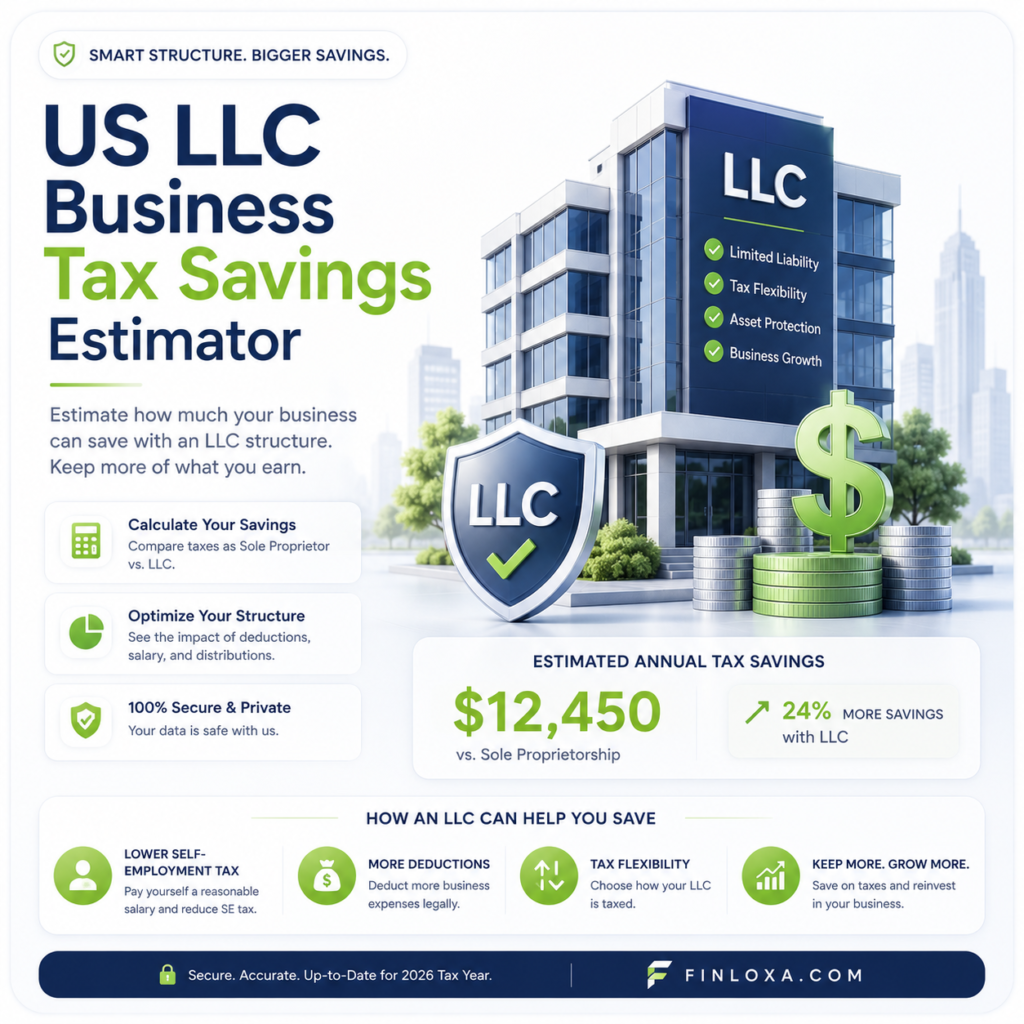
Introduction: Maximizing Business Deductions via the LLC Tax Calculator
Scaling an e-commerce brand out of Miami or operating a digital consulting agency in Seattle requires absolute control over your federal tax liabilities. Most American startup founders and single-member LLC owners approach IRS filing deadlines completely blind to how improper entity classification and unoptimized self-employment taxes drain thousands of dollars from their annual net profit.
They rely on generic end-of-year estimates, celebrating gross revenue milestones while completely ignoring the federal compliance frameworks that could shelter substantial portions of their income from excessive FICA withholdings. This reactive approach creates a major operational roadblock: without leveraging a dedicated LLC Tax Calculator, you file your Schedule C blindly, only to discover a massive IRS tax bill because your quarterly withholding strategy failed to account for state-level pass-through adjustments and federal deductions.
Core Benefits of Using an Advanced Tax Estimator:
- Accurate Self-Employment Tax Projections: Instantly calculate your exact 15.3% Social Security and Medicare obligations before the IRS quarterly due dates.
- S-Corp Election Cost-Benefit Analysis: Determine the precise revenue threshold where electing corporate tax status saves you thousands on payroll taxes.
- State-Specific Compliance Mapping: Factor in unique state tax dynamics ranging from zero-income tax states like Texas to high-rate states like California.
Key Takeaway / Quick Summary
A reliable LLC Tax Calculator safeguards your business capital by projecting federal and state liabilities with precision. By auditing business expenses and tracking quarterly thresholds early, US entrepreneurs can systematically reduce audit risks and keep more cash inside their operating accounts.
The definitive path to sustainable corporate tax optimization requires an immediate workflow upgrade. By running your company balance sheet through an automated evaluation engine driven by a professional LLC Tax Calculator, you secure the mathematical clarity needed to outmaneuver complex IRS guidelines and maximize your bottom line.
Tax & Financial Disclaimer: The tax estimations, business deduction frameworks, and calculation utilities provided on Finloxa.com are intended strictly for educational, strategic planning, and informational purposes. They do not constitute formal CPA advice, legal counsel, or guaranteed IRS audit protection. Individual corporate tax obligations vary based on gross receipts, local jurisdictions, and congressional updates; always verify official filing parameters directly with a certified public accountant or the Internal Revenue Service.


LLC Tax Savings Calculator 2026 – Save on Business Taxes USA
Step-by-Step Execution Guide
Structuring your business properly can substantially lower your annual federal and state liability. Using an advanced LLC Tax Calculator allows business owners to evaluate S-Corp election benefits, optimize reasonable salary distributions, and maximize eligible pass-through write-offs before filing their annual business returns.

Step 1: Preparation
Gather your annual net profit figures and current entity classification data to establish your baseline self-employment tax burden under default IRS rules.
- Calculate Total Net Business Income: Tally your gross earnings minus direct operational costs to determine taxable pass-through profits.
- Benchmark Default Self-Employment Taxes: Track standard 15.3% SECA taxes (12.4% Social Security + 2.9% Medicare) paid on single-member or partnership profits.
- Leverage an LLC Tax Savings Estimator: Utilizing a high-fidelity LLC tax savings estimator helps reveal exact threshold limits where converting to an S-Corporation eliminates unnecessary self-employment tax overflow.
Step 2: Implementation
Run dynamic tax scenarios inside our interactive LLC Tax Calculator to simulate wage distributions and pass-through write-offs.
- Determine Reasonable Officer Compensation: Allocate a realistic W-2 salary for working owners to meet IRS guidelines while taking remaining earnings as tax-exempt distributions.
- Maximize Section 199A QBI Deductions: Take advantage of up to a 20% Qualified Business Income deduction on qualified pass-through profits.
- Write Off Legitimate Operating Costs: Deduct vehicle mileage, home office square footage, health insurance premiums, and professional equipment expenses.
Step 3: Review and Finalize
Lock in your optimal business structure, file necessary IRS tax election forms, and maintain compliant recordkeeping throughout the tax year.
- File IRS Form 2553 on Time: Submit your S-Corporation election within 75 days of the start of the tax year to claim current-year savings.
- Schedule Quarterly Estimated Taxes: Remit federal and state quarterly payments on Form 1040-ES to avoid underpayment interest charges.
This LLC tax strategy framework strictly complies with standards issued by the Internal Revenue Service (IRS) and federal pass-through entity regulations under the Tax Cuts and Jobs Act (TCJA).
🛠️ Business Tax Strategy Tip: Once your LLC generates over $80,000 in annual net profit, electing S-Corp status can save you thousands in self-employment taxes each year by splitting profits into salary and distributions.