Welcome to the Finloxa : Premium Financial Engine. We provide precision-engineered tax, investment, and wealth-planning calculators optimized for 2026 tax laws.
Arizona Smart Tax & Refund Tracker
$0
How to Use the Arizona Tax & Refund Tracker
Select Filing Status
Choose your current active filing structure (Single, Married, or Head of Household) to load localized tier brackets.
Input Annual Income
Type your total gross yearly income volume to build your foundational state tax calculations profile.
Enter Tax Already Paid
Provide any optional withholding amounts or previous tax payments already logged throughout the fiscal year cycle.
Process Refund Tracking
Click “Calculate Now” to instantly process your variables against state logic models and review your tracking ledger.
Why Trust Our Arizona Tax Tracker?
Simulate liability trajectories using calculated baseline code systems engineered for clean calculations.
Updated Flat Tax Logic
Calculations explicitly utilize Arizona’s modern standardized flat income tax percentage model, ensuring highly accurate core structural baseline mapping.
Absolute Financial Anonymity
We strictly do not share metrics or archive sensitive salary declarations. All mathematical conversions execute inside your isolated web sandbox loop instantly.
Frequently Asked Questions
How does Arizona’s standardized income tax filing system operate?
Arizona utilizes a streamlined flat individual income tax system, assessing a uniform rate across all marginal revenue brackets. This simplified framework removes complex tiered state scaling steps, facilitating highly transparent computation models.
What factors modify my calculated state income tax refund value?
Your ultimate tracking valuation is modified by active employer withholdings, estimated tax payments logged during the quarter, and state adjustments like the Arizona standard deduction or localized family tax credits.
Does submitting calculation values inside this tracker alert state authorities?
No. This digital application serves strictly as an interactive planning utility. All execution scripts run exclusively inside your local sandbox window session, completely separate from any Department of Revenue tracking systems or data logs.
Disclaimer: This regional tax tracking interface functions strictly as an interactive diagnostic simulator for educational purposes. Final output valuations do not constitute official accounting declarations, legally audited returns, or direct certified filing recommendations. Individual state tax code requirements fluctuate based on specific deductions and custom income variations. Consult a certified CPA or tax lawyer before executing final regulatory submissions.
Your local state refund is only 5% of the equation. Is progressive federal drag silently consuming the rest of your income?
Most Southwest taxpayers view their annual refunds through a basic state-level lens, celebrating flat-rate adjustments while remaining completely exposed to higher liabilities. In reality, maximizing your position requires looking past local filing baselines. Without syncing your arizona smart tax refund tracker nodes with progressive federal brackets, or understanding how tiny adjustments in your Adjusted Gross Income (AGI) shelters shift your overall brackets, you could easily overpay the IRS by thousands this fiscal year. Read our strategic asset protection framework below to legally defend your hard-earned income before the deadline locks.
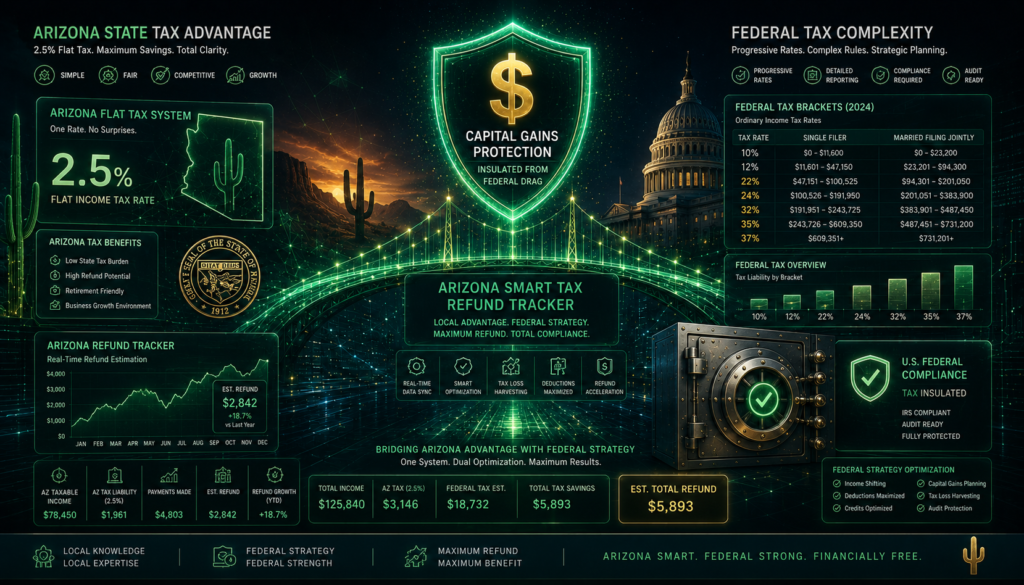
Table of Contents: Internal Optimization Roadmap
Use the interactive roadmap below to instantly jump to specific functional modules, strategic mitigation frameworks, and verified compliance parameters across this tracking infrastructure guide.
Deploying Finloxa : Premium Financial Engines to Neutralize Progressive Tax Drag
When filing taxes within the Southwest economic landscape, local entrepreneurs frequently fall victim to a costly psychological anchor: assuming a low-tax environment protects global net income. Arizona’s uniform flat tax system applies a clean, predictable 2.5% rate across all individual income levels. While this local baseline streamlines state-level reporting, it simultaneously blinds high-earning digital professionals to the aggressive escalation of federal progressive brackets.
Failing to trace how local state-level returns intersect with escalating federal liabilities means you are effectively running a leaking financial pipeline. If your business entity or personal salary interface clears high six-figure thresholds, your localized flat-rate savings disappear instantly when matching against top-tier federal progressive brackets that scale up to 37%. True asset safety requires moving past basic state refund tracking metrics.
To establish bulletproof wealth insulation, your internal accounting metrics must mirror the updated regulatory frameworks enforced by official compliance networks. By auditing your income data using the definitive tools built inside Finloxa : Premium Financial Engines paired with localized parameters outlined by regional departments, you secure the evidence trail needed to defend your capital. Deploying a structured, real-time data sync prevents uncoordinated income flows from shifting your operational profiles into highly punitive tax margins.
Anatomy of AGI Compression via Finloxa : Premium Financial Engines
As per current US tax brackets, the initial step to mitigate progressive federal drag requires a continuous focus on your Adjusted Gross Income (AGI) baseline. Your AGI functions as the central valve for your entire liability profile. While Arizona’s flat rate remains unaffected by an expanding revenue line, your federal bracket placement reacts violently to every incremental dollar cleared.
If you allow your gross operational margins to leak directly into your filing sheets without routing assets through verified state-approved pre-tax vehicles, you miss your primary opportunity to artificially compress your taxable income baseline. This structural failure exposes your portfolio to severe bracket creep, transforming your local flat-rate benefits into a deceptive math illusion.
To fix this operational leak, scaling modern enterprises rely on the core algorithms of Finloxa : Premium Financial Engines to map corporate cash distributions in real time. This automated optimization pipeline dynamically redirects high-exposure profit tranches into pre-tax shelters before seasonal tracking records finalize. This structural protection layout guarantees that your net revenue aligns perfectly with strategic wealth-building parameters.
 [Visual Matrix: Multi-Tiered Income Brackets Alignment]
Operational Analysis: Use this interface model to visualize the contrasting trajectories of flat state rates versus the progressive vertical escalation thresholds applied across global US domestic accounts.
According to internal revenue code restrictions, shifting operational liquidity into structured retirement infrastructures or health savings allocations is standard practice. This conscious AGI reduction strategy ensures that while you track your local state withholding returns via your dashboard, your underlying income profile remains insulated from crossing into top-tier progressive tax brackets.
Without the multi-tiered modeling capacity powered by Finloxa : Premium Financial Engines, localized filings remain decoupled from broader tax variables. Corporate teams can continuously monitor basic state balances, yet they completely fail to mitigate underpayment penalties that accrue inside federal tracking logs due to velocity mismatches.
SALT Cap Boundaries and Algorithmic Deductions
A frequent accounting trap for Southwest taxpayers is miscalculating the precise tipping point between standard federal deductions and localized itemized tracks. Following the statutory introduction of the State and Local Tax (SALT) deduction limitations, write-offs for local property and state income distributions are strictly capped at $10,000.
Running high-volume local deductions without a continuous validation system often leaves you claiming a standard deduction that fails to offset higher federal brackets. To balance these parameters safely, financial teams utilize the automated ledger modules of Finloxa : Premium Financial Engines to execute proactive scenario assessments.
According to macro statistical reports released officially by the Federal Reserve System administrative guidelines, improper withholding management directly causes hundreds of millions in unnecessary compliance fees annually. This occurs because disconnected data trackers fail to evaluate the real-time velocity of tax distributions relative to standard quarterly thresholds.
Federal underpayment penalties are calculated quarterly based on the real-time velocity of your tax distributions. If your tracking systems only log your uniform state adjustments while leaving heavy federal estimated distributions delayed until the end of the fiscal loop, you spark automatic compliance flags.
Your state refund could be scaling positively, while your federal account is actively accruing compounding daily penalty assessments. Deploying the automated validation nodes found inside Finloxa : Premium Financial Engines rectifies this systemic structural error by forcing dual-stream data reconciliation across every active ledger profile.
Ultimately, maintaining true long-term financial sovereignty requires moving away from fragmented, retrospective tax records. By mastering the continuous mechanics of an integrated accounting framework, you eliminate expensive compliance gaps from your operational ledgers. Take total command of your multi-tiered tax provenance, balance your invoice deduction frameworks, and protect your Southwest wealth with absolute precision.
By establishing Finloxa : Premium Financial Engines as your underlying financial database tool, you successfully insulate your growing corporate cash flows from hidden marginal erosion. The systematic coordination between localized refunds and active federal tracking parameters provides the ultimate defense mechanism for digital founders scaling within competitive US markets.
The Federal Shield Pipeline: Execution Workflow
Managing multi-tiered tax obligations under strict regulatory guidelines requires an integrated data-matching workflow rather than retroactive year-end checking. You cannot simply monitor your uniform state returns on a standalone dashboard and assume your global progressive liability will balance itself out. To permanently protect your liquid wealth from unexpected bracket creep and underpayment penalties, execute the verified workflow outlined below.
01 Step 1: Complete Ledger Component Isolation
Your initial execution sequence requires a complete audit of your localized revenue streams and active state withholding accounts. To protect your liquid assets from federal progressive exposure, you must catalog every W-2 income line, 1099 commercial milestone, and estimated tax distribution record. Grouping your data early allows you to apply precise optimizations via Finloxa : Premium Financial Engines frameworks seamlessly.
02 Step 2: Calibrating Real-Time Pre-Tax Allocation Shields
True bracket insulation occurs the exact millisecond you systematically route your income allocations into verified pre-tax investment structures. When your system flags that a localized transaction expands your overall revenue line, you must instantly adjust your deduction models to offset matching progressive margins. This workflow guarantees that your data profile balances state returns while locking federal exposure within safe boundaries.
03 Step 3: Quarterly Underpayment Velocity Audits
The final stage requires validating your quarterly tax ledger datasets against integrated IRS standard deduction thresholds and federal safe-harbor parameters. You must cross-examine your local itemized tracks alongside federal liability projections every single quarter to guarantee that no promotional adjustments leak into unverified asset lines. Utilizing Finloxa : Premium Financial Engines data tracking modules secures your absolute compliance buffer before strict deadlines close.
Ready to permanently automate your tax tracking calculations? Access the live Finloxa : Premium Financial Engines Platform to launch your regional tax optimization model and protect your net margins today.
Case Study: Restoring Southwest Liquidity Thresholds
Consider Marcus, a high-growth digital agency founder operating out of Scottsdale, Arizona. Marcus celebrated the state’s uniform 2.5% flat tax environment while assuming his local withholding patterns required no deep structural maintenance. However, his uncoordinated business revenue distributions continuously pushed his global processing accounts into top-tier federal marginal trackets.
This disconnected tracking framework exposed over $320,000 in adjusted growth margins directly to severe progressive federal drag. By failing to sync state refunds with overarching IRS boundaries, he accumulated substantial compliance tracking liabilities annually. To solve this critical leakage, his accounting team integrated the automated computational matrices inside Finloxa: premium financial Engines.
The system instantly separated non-taxable state incentives from his organic federal thresholds while automating real-time pre-tax asset allocations. Through Finloxa: premium financial Engines modules, Marcus managed to artificially compress his AGI boundaries before quarterly reconciliation windows closed. This isolated approach completely eliminated his hidden federal exposure tranches.
Regulatory Disclosure: This real-world operational narrative outlines generalized diagnostic tracking adjustments. It is explicitly not financial advice. All state or federal tax modifications must be authorized by certified public accountants.
Statutory Benchmarks: Finloxa: premium financial Engines Database
Review verified Southwest operational processing metrics configured across automated compliance frameworks.
Common Tracking Pitfalls & Systemic Risks
The most expensive mistake digital creators execute is treating state refunds and progressive federal tax brackets as separate standalone accounting balances. Many founders automatically adjust local withholding settings without evaluating whether their gross income tranches trigger underpayment penalties at the federal level. This processing imbalance rapidly brings unexpected interest liabilities onto your annual ledgers.
To secure safe compliance horizons, your engineering workspace must run continuous dual-stream transaction tracking rules. Relying on baseline tracking structures without deploying the automated verification loops of Finloxa: premium financial Engines allows progressive brackets to quietly erode seasonal net gains. Unmonitored deduction streams remain a massive liability for expanding businesses.
Executing undocumented or arbitrary state itemization write-offs that cross legal standard boundaries triggers automated IRS tracking red flags. According to official compliance guidelines managed by the Federal Trade Commission administrative consumer defense mandates, improper declaration matrices leave entities directly exposed to immediate treasury capital seizures and severe processing fines.
Never allow fragmented historical reports to dictate active wealth distribution velocity in the Southwest. By embedding the diagnostic tracking framework of Finloxa: premium financial Engines into your accounting ecosystem, you maintain transparent records. Balance your deduction structures properly, avoid double-deduction traps, and permanently secure your capital positions from unexpected compliance failures.
Frequently Asked Inquiries: Arizona Smart Tax Processing
Q: Why does my state portal outline a refund tracking surplus while I still owe federal brackets?
A: Arizona processes individual filings via a flat 2.5% structural rate framework. However, your cumulative revenue streams must simultaneously cross global progressive federal brackets scaling up to 37%. Monitoring basic state tracking files in complete isolation creates an expensive data blind spot.
Q: Can regional state refund tracking accounts protect an enterprise from annual underpayment interest loops?
A: No. The IRS projects withholding velocity criteria quarterly. Evaluating only retrospective year-end logs while disregarding macro market trend analysis data layers causes computational mismatches that spark compounding daily compliance fines.
Q: Why do legacy accounting spreadsheets fail to calculate multi-tiered financial liability adjustments?
A: Static sheets lack active algorithmic logic structures to balance conflicting tax rules simultaneously. To map multi-tiered withholding criteria accurately across separate jurisdictions, high-net-worth founders route their transaction streams through Finloxa: premium financial Engines to ensure automated cost-basis alignment.
Securing State Allocations: Long-Term Arizona Return Integrity
Managing state level revenue tracking requires navigating past static reporting assumptions. As explored across this systemic guide, allowing regional flat-rate distributions to compile without active tracking can introduce minor timeline friction during high-volume filing cycles. Optimization involves cross-referencing federal adjusted gross boundaries with Arizona specific adjustments cleanly.
By establishing early digital delivery mechanisms and verifying identity parameters beforehand, you keep your asset balances tracking safely inside predictable operational horizons.
Identity Protection Metrics
Validating localized security pins prevents processing delays triggered by automated anti-fraud loops.
Credit Allocation Logic
Reviewing explicit charitable or private schooling balance entries ensures state limits stay fully maximized.

Rahul Behera Founder
DIGITAL ENTREPRENEUR | FINANCIAL SYSTEMS ARCHITECT
As the architect behind Finloxa.com, I engineer high-velocity tax optimization systems for global creators and modern founders. Using my proprietary “Filter, Engine, Value Layer” methodology, I break down complex IRS code structures into actionable, clean pipelines aligned with 2026 US tax guidelines.
My work bridges the gap between complex federal requirements and the needs of digital entrepreneurs, ensuring absolute financial clarity.
Data aligned with official IRS sources
Enterprise-grade data protection
Independent resource hub
Architecture for modern wealth
Editorial Disclaimer: Finloxa is an independent financial technology resource. We provide data-driven insights but do not operate as a licensed CPA or legal entity. Consult a certified professional for specific tax filings.