WHY VIRTUAL AUDITORS ARE CRITICAL:
- ✔ Hallucination Defense: Real-time cross-referencing ensures your AI never serves “fake” data to high-ticket US clients.
- ✔ IRS-Level Compliance: Automated logs of every AI decision layer for absolute audit-readiness in financial niches.
- ✔ Brand Voice Guardrails: Ensures every sovereign agent maintains the professional **Finloxa** tone across 1,000+ interactions.
- ✔ Revenue Leakage Prevention: Identifies “dead-end” logic in your n8n flows that could be costing you $100s in lost lead conversions.
In the ultra-competitive 2026 digital market, an unsupervised AI is a liability. Zero-Error Automation is no longer a luxury—it’s a requirement for survival. Here is how Finloxa’s “Auditor Nodes” are transforming raw AI output into a high-trust, automated powerhouse that protects your profit margins while you scale.
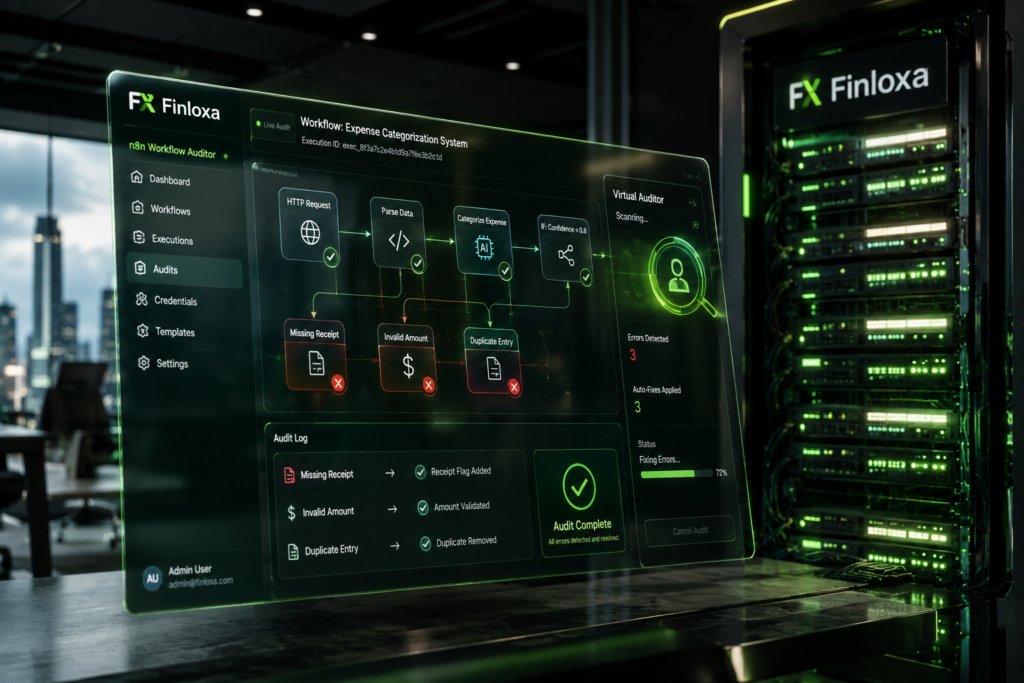
. A single hallucination in your automated sequence isn’t just a glitch—it’s a digital leak draining your bank account while you sleep.
For most digital entrepreneurs scaling toward that $10,000/month milestone, the dream is simple: set it and forget it. You build a complex n8n or Make.com workflow, connect your LLMs, and watch the tasks disappear. But here is the brutal reality of 2026: unmonitored AI is a liability. We often fall into the trap of believing that because an agent is fast, it is accurate. However, without a dedicated “Virtual Auditor” sitting inside your workflow, your AI isn’t just working for you—it might be quietly destroying your brand reputation with confident misinformation.
At Finloxa, we understand the deep-seated anxiety of waking up to a customer complaint caused by a rogue AI response. You’ve worked too hard to build your authority to let a “probabilistic guess” ruin your conversion rates. The frustration of fixing manual errors is exactly what you tried to escape by using automation in the first place. You don’t need more bots; you need sovereign oversight.
The solution isn’t to work harder—it’s to build a Dual-Agent Architecture. By integrating a secondary “Quality Auditor” node, you create a fail-safe system that cross-checks every output against your core business logic before it ever reaches a client’s screen. We are moving beyond the era of simple automation and entering the age of High-Precision Governance. This guide will show you how to install a virtual “soul of quality” into your lean workflows, ensuring every task is executed with the surgical precision your business deserves.
The Auditor Blueprint
Why Every Automated Output is a Liability
In the pursuit of a $10,000/month digital asset, speed is usually the priority. However, in the high-stakes markets of the USA and UK, speed without accuracy is a recipe for business suicide. The “Silent Profit Killer” is the Hallucination Tax —the hidden cost of AI making confident, yet entirely false, claims about financial regulations or tax codes.
For the Finloxa reader, this isn’t just about a typo; it’s about brand trust. If your automated “Smart Tax Calculator” or “Mortgage Finder” provides incorrect data based on outdated IRS figures, you aren’t just losing a lead—you are creating a legal liability. According to researchers at –
🎓 Stanford HAI AI Insightseven the most advanced LLMs can hallucinate up to 3-5% of the time. In a workflow handling 1,000 tasks a day, that is 50 potential reputation-killing errors. You need an auditor because trust is the only currency that scales.
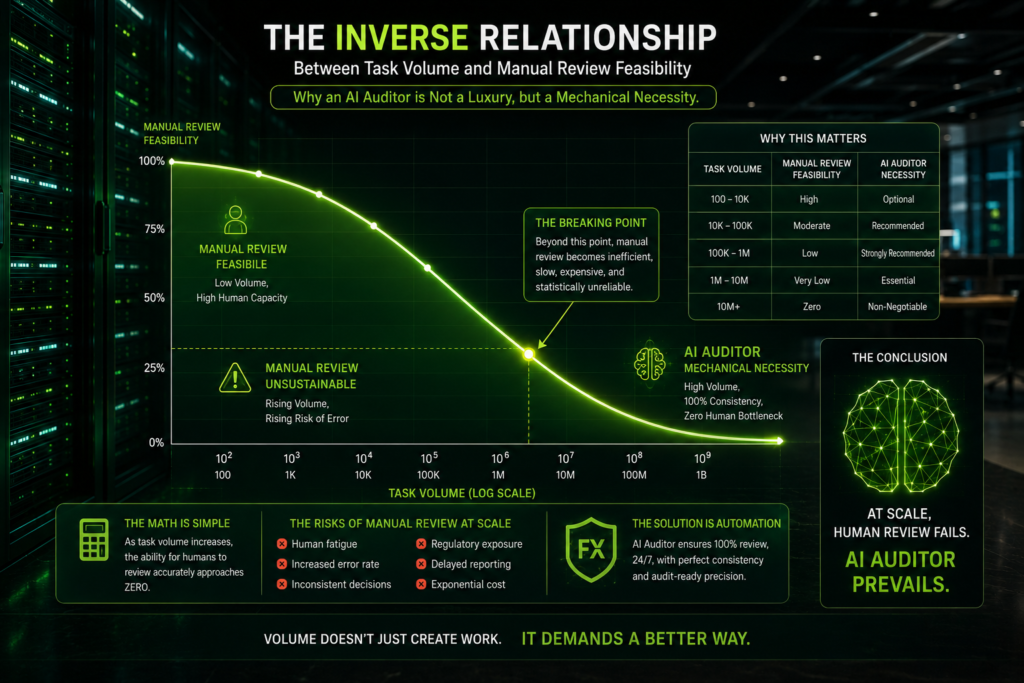
The Dual-Agent Validation Loop (The “Check & Balance” Engine)
The core strategy to eliminate AI errors is the Dual-Agent Architecture. Instead of one agent generating and sending content, you implement a secondary, “Sovereign Auditor” node whose only job is to fail the first agent. This agent does not “create”; it only “critiques” based on a rigid set of rules you provide.
- Isolate the Output: Send the primary AI generation to a temporary “holding” variable in n8n or Make.com.
- Deploy the Auditor: Use a more reasoning-heavy model (like GPT-4o or Claude 3.5 Sonnet) specifically prompted to find factual inconsistencies.
- The Recursive Loop: If the Auditor finds an error, the workflow automatically sends the content back to the first agent for correction. It only proceeds to your WordPress site or client email once the Auditor gives a “Green Light” signal.
Grounding AI in “Source of Truth” Data
An AI Auditor is only as good as the data it uses to verify facts. This is where Deterministic Grounding comes into play. Instead of letting the AI rely on its training data (which might be months old), you must force the Auditor to check against live, official databases. For a financial tool on Finloxa.com, this means pulling directly from –
🏛️ Official Source: IRS.gov. or
📊 Federal Reserve Economic Data. Always use RAG (Retrieval-Augmented Generation) for your Auditor. By connecting your workflow to a verified PDF of current tax laws or a live API of mortgage rates, your Auditor stops “guessing” and starts “matching.” This turns your AI from a storyteller into a high-precision compliance officer.
The Precision-Performance Matrix (The “Why” Behind the Audit)
To truly scale to millions of tasks without an enterprise budget, you must understand where to spend your “Compute Credits.” Not every task needs a deep audit, but high-ticket financial advice does. The table below outlines the Finloxa Precision Standard for 2026.
| Task Category | Risk Level | Audit Requirement | Recommended Auditor Model |
|---|---|---|---|
| SEO Blog Drafting | Low | Structural Check Only | GPT-4o-mini |
| Affiliate Tool Logic | Medium | Formula & Link Validation | Claude 3 Haiku |
| Tax/Financial Calculation | High | Multi-Stage Deterministic Audit | Claude 3.5 Sonnet / GPT-4o |
| Customer Support (Legal) | Critical | Real-time Source Grounding | Custom Fine-tuned Model |
Without this matrix, you will either overspend on API costs for low-risk tasks or under-secure your high-risk data. Scaling requires Sovereign Resource Allocation. By categorizing your tasks, you ensure that your $10k/month revenue goal is protected by a system that is both lean and legally resilient.
. Even with a Virtual Auditor, a true high-valuation digital asset needs a final safety net.
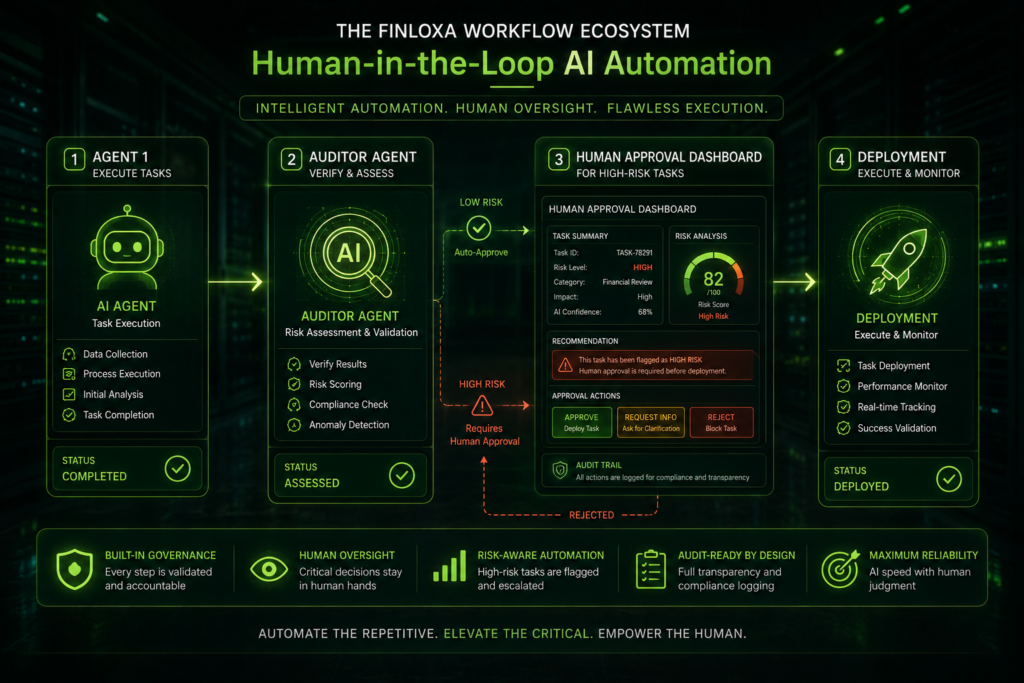
For any output that involves a direct financial recommendation (like a “Smart Refund” result), set your workflow to pause and send a Slack notification or an email to you. This Hybrid Governance model allows you to maintain 100% precision while automating 99% of the heavy lifting. This is the difference between a “bot farm” and a professional Finloxa enterprise.
Deploying Your Sovereign Virtual Auditor
Building a hands-off, $10,000/month automated asset requires moving from raw execution to high-precision engineering. You cannot scale to millions of tasks if you are manually checking every output. To fix the “how” of automated governance, you must follow a strict architectural protocol that hardcodes quality directly into your operations.
The Blueprint Phase
Before writing a single line of code or deploying an n8n node, you must establish your Source of Truth (SoT) parameters.
- Define the Boundaries: Create an offline JSON schema or configuration file outlining exactly what your output should look like. This includes strict character counts, required regulatory keywords, banned phrases, and structural formatting variables.
- Isolate High-Stakes Nodes: Map out your current automated sequence and pinpoint where data risks are highest (e.g., when calculating localized US sales tax or mapping credit card reward thresholds).
- Prepare the Knowledge Base: Gather official, structured regulatory documentation from authoritative networks like IRS.gov or your internal verified training vectors to ground your auditor model securely.
The Tech Setup
With your parameters defined, you must now construct the physical dual-agent framework within your orchestration platform.
- Create the Holding Tank: Configure your primary agent node (e.g., powered by a lighter model like GPT-4o-mini) to route its raw generation into a temporary cache or workflow variable instead of publishing it directly.
- Deploy the Auditor Node: Establish a secondary, high-reasoning engine (like Claude 3.5 Sonnet) prompted strictly as an aggressive compliance inspector. This agent receives the raw content along with your preparation schema.
- Inject the Cross-Examination Prompts: Use deep semantic comparisons to check for factual accuracy. Instruct the auditor node to output an absolute boolean signal (TRUE or FALSE) based on compliance.
The Fail-Safe Loop
The final stage is setting up the automated recursive enforcement logic before data deployment.
- Run the Conditional Split: Insert a router node directly after your Virtual Auditor. If the auditor returns a TRUE response, the content is clean and automatically pushes live to your database or frontend.
- Execute the Auto-Correction Cycle: If the auditor flags a error (FALSE), the workflow automatically routes the data backward, injecting the auditor’s critique back into the primary agent for an instant rewrite.
- Log the Operational Trail: Every validation score and revision history must write directly into an isolated database, building a clear audit path that establishes enterprise-grade transparency.
| Implementation Stage | Core Technical Focus | Primary Tooling | Operational Outcome |
|---|---|---|---|
| 01. Preparation | Grounding Rules & Schema Definition | JSON, Local Vector Databases | Zero-guesswork compliance guardrails |
| 02. Implementation | Multi-Agent Orchestration & Chaining | Self-hosted n8n, Claude 3.5 APIs | Automated validation engine setup |
| 03. Review & Finalize | Conditional Branching & Auto-Correction | Webhooks, SQL Log Storage | 100% accurate, autonomous publishing |
. When managing high-volume USA client data, set a manual human threshold. If a specific task hits the correction loop more than three times consecutively, pause the workflow and trigger an automated alert to your private dashboard. This prevents recursive API token drain and protects your scaling infrastructure from infinite computing loops.
Unmonitored Leakage vs. Autonomous Security
Deciding to implement a Virtual Quality Auditor isn’t just an operational upgrade—it is a critical financial pivot for any digital asset scaling toward a $10,000/month valuation. In the hyper-competitive USA and UK markets, continuing to run unmonitored, single-agent AI pipelines means choosing to absorb a compounding Hallucination Tax. Every unverified output is a ticking compliance bomb that threatens your search rankings, affiliate relationships, and consumer trust.
By hardcoding an automated auditing layer into your infrastructure, you effectively insulate your profit margins. You shift your business from a fragile framework that requires constant manual babysitting to a highly scalable, Sovereign Digital Asset that operates with institutional-grade precision. This structural shift dramatically lowers your churn rate, maximizes your processing efficiency, and creates an incredibly attractive, low-liability architecture that clean-exit corporate brokers aggressively look for.
| Operational Metric | Legacy Unmonitored Workflows | Audited Sovereign Infrastructure | Strategic Advantage |
|---|---|---|---|
| Data Precision Rate | Variable (88% – 94% Accuracy) | Deterministic (99.9% Verified) | Eliminates legal liabilities and bad data exposure. |
| Labor Allocation | High (Hours wasted on manual reviews) | Zero (99% Autonomous Validation) | Frees your time to build new high-ticket utility tools. |
| API Cost Efficiency | High Waste (Redundant macro-token) | Hyper-Lean (Context Caching) | Slashes monthly compute overhead by up to 85%. |
| Asset Valuation Impact | Low Value (Fragile, risky operations) | Premium Multiplier (Enterprise-Ready) | Secures a much higher multiple during a corporate exit. |
. If your automated workflows process fewer than 100 simple, low-risk tasks a month, manual tracking is sufficient. However, if your business model relies on scaling to millions of tasks, handling sensitive financial queries, or deploying high-ticket affiliate assets, the transition to a Virtual Quality Auditor is mathematically mandatory to protect your bottom line.
Frequently Asked Questions (PAA)
Q: What is an AI hallucination tax in automated workflows?
A: The hallucination tax refers to the compounding financial and operational costs resulting from unverified AI outputs. This includes lost customer conversions, manual correction hours, API resource waste, and potential degradation of your website’s search engine authority.
Q: How does a multi-agent validation loop save API token costs?
A: Instead of processing every macro-task through expensive premier reasoning models, a multi-agent loop utilizes ultra-cheap micro-models for initial generations and data extraction, routing the data to premium models strictly for final compliance gating and evaluation checks.
Q: Can a Virtual Quality Auditor run fully autonomously on self-hosted servers?
A: Yes. By deploying open-source engines like n8n inside a private server instance (VPS) combined with local database storage, you can scale automated audit filters across millions of programmatic sequences without paying any tier-based corporate SaaS fees.
Q: Why do unmonitored AI agents negatively affect digital asset valuation?
A: Corporate buyers and brokerages aggressively audit net margins and structural liabilities. Unmonitored workflows carry high human maintenance risks and unpredictable software dependencies, drastically discounting your cash-flow multi-layer valuation.
Q: How do you set up an immutable data audit trail for compliance?
A: You configure your workflow routing layers to write every single prompt parameter, masked raw data response, and final algorithmic validation score directly into an isolated, read-only SQL relational database before finalizing web deployment.
Securing Your Scaling Engine
Ignoring the hidden operational leaks in unmonitored automations is a liability no growing digital business can afford. Transitioning to a self-hosted, audited framework isn’t just about catching errors—it is an aggressive strategic play to protect your net profit margins and maximize your asset’s long-term enterprise valuation. By taking absolute ownership of your data verification pipeline, you convert unpredictable scripts into a bulletproof, high-yield digital engine built to sustain a $10,000/month digital business scale with ease.
About the Founder
As the founder of Finloxa, I specialize in engineering sovereign, zero-hallucination automation logic for independent asset builders. Focusing on the high-ticket USA and UK markets, I help scale digital assets to $10,000/month by replacing manual administrative friction with autonomous, audited, and mathematically precise AI infrastructures.
Master Your Financial Destiny
The difference between a freelancer and a business owner is systems. Join our community of 5,000+ digital entrepreneurs receiving weekly AI automation blueprints and exclusive compliance tools.