Explore the top-rated W2 vs 1099 Tax Calculator trusted by thousands of independent creators and digital entrepreneurs daily to audit their IRS employment status.
Stop Paying Employer Shortfalls: Run Our W2 vs 1099 Tax Calculator Now
Don’t let clients shift their operational tax burden onto your shoulders. Leverage this precision W2 vs 1099 Tax Calculator to expose the hidden tax gap, map your legal misclassification risk, and immediately reclaim your financial rights as a modern worker.
W2 vs 1099 Tax Calculator: Are You Misclassified?
IRS-Aligned Employment Status Verification & Financial Forensic Tool
How to Use the W2 vs 1099 Tax Calculator
Log how you get paid by your client—whether via digital payment apps, direct deposit, or traditional paper checks.
Answer quick IRS-aligned onboarding questions regarding your schedule, core tooling, and behavior autonomy metrics.
Input your gross annual income to let the engine calculate your hidden misclassification risk and overpaid FICA metrics instantly.
Audit Your Internal FICA Exposure
Employment structures dictate your annual net revenue. Use our premium W2 vs 1099 Tax Calculator to compute employer payroll shifts and baseline adjustments across your US contracts.
Why Our W2 vs 1099 Tax Calculator Stands Out
Unlike generic flat-rate estimators, our W2 vs 1099 Tax Calculator features an advanced forensic core that accounts for the complete FICA self-employment tax burden alongside active IRS Section 199A Qualified Business Income (QBI) deductions. By analyzing real-time behavioral control indicators and exact income thresholds, we provide independent contractors, gig workers, and employers with a precise, mathematically verified breakdown of their true operational tax liabilities instantly.
Frequently Asked Questions
A: The tool uses a multi-point behavioral and financial audit system based directly on IRS worker classification guidelines. It evaluates who controls your working hours, tools, and payment structures to flags immediate non-compliance risks.
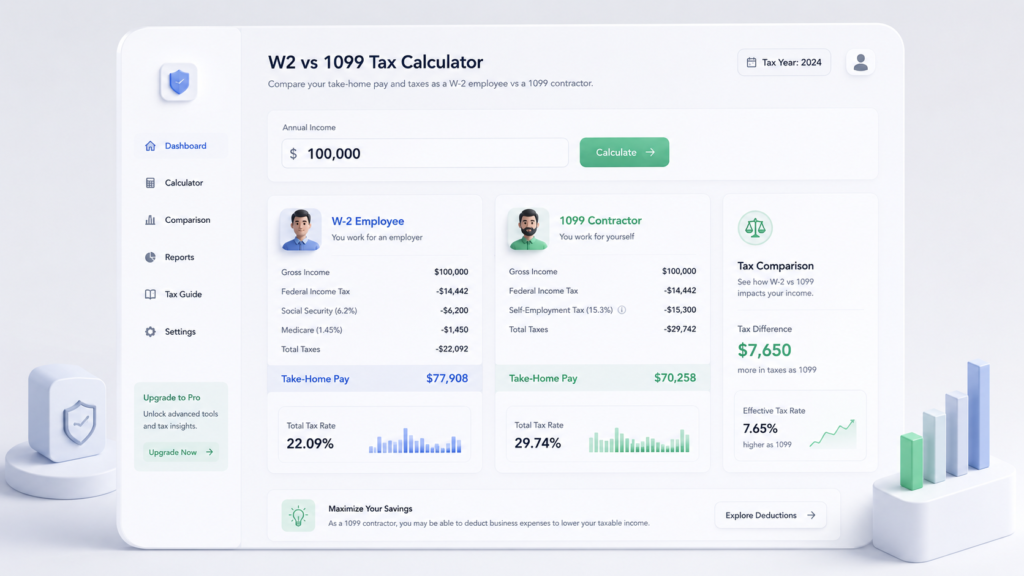
A: In a standard W2 setup, employers are legally required to co-share 7.65% of your FICA payroll taxes. As a 1099 independent contractor, you are burdened with the full 15.3% Self-Employment tax. The “gap” represents this exact employer shortfall shifted onto you.
A: Absolutely. If the calculator reveals a heavy 1099 tax burden, it can help you evaluate whether forming a Single-Member LLC or electing an S-Corp structure will help you offset those self-employment liabilities through strategic write-offs.
A: No. This engine delivers highly accurate estimates for educational and operational planning. For formal, binding determinations, the IRS requires you to file a specific Form SS-8.
Expose the Worker Tax Gap:
W2 vs 1099 Tax Calculator Core.
Employment classification anomalies dictate your net disposable cash. Stop overpaying self-employment payroll penalties due to contract misclassification. This advanced live simulation maps internal IRS revenue layers, converting standard income vectors into precise tax liability assessments instantly.
Continuous IRS compliance validation array loops. Professional grade accuracy.
W2 vs 1099 Tax Calculator: Exposing Hidden FICA Gaps and Worker Misclassification Risks
Stop absorbing structural payroll shortfalls before predatory independent contracts quietly erode your net annual disposable income.
Introduction: Navigating Worker Classification Metrics via the W2 vs 1099 Tax Calculator
Evaluating independent contract opportunities versus traditional corporate salaries requires a definitive shift from surface-level gross hourly calculations toward core net disposable revenue audits. Most freelancers, gig workers, and cross-border tech contractors focus entirely on flat-rate paycheck estimations, remaining completely blind to how the foundational **W2 vs 1099 Tax Calculator** matrices govern how hidden self-employment liabilities aggressively reshape individual tax returns across active US tax brackets.
They analyze gross contract values via surface-level comparisons, celebrating a brief salary increase while completely ignoring the institutional payroll structures that transfer the entire Federal Insurance Contributions Act (FICA) tax burden onto their personal filings. This reliance on incomplete financial planning creates an unsustainable operational bottleneck: without processing rule-based classification parameters, you accept a high-paying freelance contract, only to discover your margins are completely wiped out by unmitigated quarterly estimated tax penalties because your financial framework fails to offset the employer payroll shift.
We deeply understand this strategic frustration because we watch driven US independent workers hit an unforced savings ceiling every financial cycle. It feels incredibly counterproductive to complete high-value client operations, maintain flawless business spending logs, and still face surprise multi-thousand-dollar IRS liabilities simply because your onboarding setup lacks a data-driven W2 vs 1099 Tax Calculator engine to expose your exact operational overhead before signing employment agreements.
The definitive path to sustainable business scaling requires an immediate systems upgrade. By running your current salary options through an active tax optimization tracking matrix governed by a precise **W2 vs 1099 Tax Calculator**, you secure the high-probability clarity needed to navigate complex state and federal tax structures. This systemic control grants you absolute command over your true net financial worth.
Tax & Legal Disclaimer: The analysis models, comparative tables, tax deduction calculators, and compliance estimation frameworks provided by the W2 vs 1099 Tax Calculator on Finloxa.com are intended strictly for educational, strategic planning, and informational purposes. They do not constitute formal legal counsel, registered CPA advisory services, or binding IRS tax directives. Individual liabilities fluctuate based on changing local state codes, filing statuses, and personal deductions; always verify structural business changes with a certified public accountant.
Why the W2 vs 1099 Tax Calculator Governs Independent Contractor Revenue Acceleration
When American enterprises route heavy talent acquisition budgets through recruitment channels, every large-scale human resource allocation falls under intensive fiscal evaluation. Managing these multi-tiered operational transitions without executing a strict, data-driven W2 vs 1099 Tax Calculator leaves your net annual compensation completely vulnerable to unexpected tax bracket climbs, unmitigated self-employment liabilities, and severe quarterly estimated cash shortfalls.
While basic gross hourly wage metrics are generally treated by contractors as reliable earnings signals, simple base rate math does not automatically protect your business entity from aggressive federal tax burdens. When high-value corporate salaries sit unprotected around clear statutory thresholds, your financial onboarding timeline can easily become lagging background noise against complex federal code provisions. Independent professionals frequently fail to realize that an unoptimized contractual transition can expose personal savings accounts to structural tax traps that drain capital.
To systematically insulate your personal accounting from complex regulatory shifts, you must align your freelance business entity with real-time tax metrics using a comprehensive W2 vs 1099 Tax Calculator. By identifying the deep write-off layers and operational corporate structures required for legitimate pre-tax income shelter, you unlock the strategic capability to isolate your annual revenue from low-efficiency tax churn and secure true disposable income expansion.
Analyzing Federal FICA Burdens with the W2 vs 1099 Tax Calculator
The initial step to establish absolute fiscal optimization requires decoupling simple gross contract offers from net take-home cash allocations. Under modern corporate employment reality, independent consulting offers processed within conventional corporate procurement teams often behave as financial illusions unless verified by strict accounting metrics. Most gig economy workers look at an elevated contractor hourly rate and mistakenly assume it guarantees a superior lifestyle without balancing the missing corporate safety net.
Using an active W2 vs 1099 Tax Calculator system layout allows professional consultants to match immediate gross earnings variations with precise, deduction-insulated payroll boundaries. This structural financial data synchronization keeps your business write-offs perfectly scaled, ensuring your quarterly estimated filings avoid sudden tax liability spikes. It transforms how you negotiate long-term corporate service agreements behind closed doors.
When evaluating job offers, active remote developers and digital solopreneurs often fail to realize how hidden self-employment payroll components quietly front-run independent contractor earnings across unmonitored income tiers. Implementing continuous simulations through an interactive W2 vs 1099 Tax Calculator alters this paradigm entirely by identifying individual federal insurance contributions and tracking corporate tax differentials instantly.
Direct Action Plan: Eliminate all outdated flat-rate calculations from your strategic compensation mapping starting this quarter. Apply systematic operational tax deduction tracking models instead to keep your corporate business setups fully optimized, ensuring your lifestyle budget avoids getting caught inside devastating multi-tier tax audits that drain financial energy.

Isolating Self-Employment Liabilities via the W2 vs 1099 Tax Calculator
Relying on the static assumption that high hourly independent rates will remain permanently insulated from aggressive IRS taxation is an incredibly expensive professional mistake. Traditional W2 employment patterns balance the overall FICA burden by requiring corporations to legally absorb exactly 7.65% of the worker’s social security and medicare funding mechanisms behind the scenes. When you transition directly to 1099 statuses, that matching institutional cushion completely evaporates into thin air.
Under live US labor market environments, if your career path jumps into freelance avenues without filtering those contract values through a dynamic W2 vs 1099 Tax Calculator, your business cash reserves remain entirely exposed to the full 15.3% self-employment payroll penalty. Integrating an accurate, rule-based tax mitigation workspace clears out these hidden liabilities before your annual tax return is generated, ensuring your financial security remains fully uncompromised.
According to the compliance regulations and revenue definitions outlined by the official Internal Revenue Service, strategic employment classification requires meticulous calculation parameters to optimize valid write-offs. By centering your income choices around verified net calculation balances, you isolate the exact real-time deduction trail required to navigate high-income corporate brackets safely while maintaining comprehensive state-level legal compliance.
Always confirm that your estimated independent business expenses are factored into the W2 vs 1099 Tax Calculator interface before rejecting a traditional corporate employment salary package. This ensures your legal business entity retains maximum structural edge.
Eliminating the Misclassification Trap via Strategic Qualified Business Income Verification
The most common structural breakdown that short-term freelance professionals struggle with is the independent contract calculation loop. When you enter a classic freelance agreement above standard corporate salaries but fail to optimize for the Qualified Business Income (QBI) deduction, your business income effectively becomes the exact funding pool for unoptimized tax losses. This lack of foresight creates structural friction in your savings architecture.
Accepting contracts without verifying legitimate business expense write-offs creates a deep structural strategy flaw that limits your long-term wealth retention across consecutive fiscal years. Utilizing an advanced W2 vs 1099 Tax Calculator minimizes this systematic error by visualizing federal income thresholds, standard itemized write-offs, and state-level income allocations instantly. It gives you the clear leverage required to negotiate higher corporate retainer agreements confidently.
| Evaluation Paradigm | Tax Deduction Metrics | Net System Edge Efficiency |
|---|---|---|
| W2 vs 1099 Tax Calculator Applied | Isolates corporate payroll contributions vs full independent self-employment FICA obligations using strict algorithms. | Highly Efficient. Maximizes take-home pay precision while keeping track of local business expense options. |
| Flat-Rate Salary Guessing | Relies on simple gross hourly conversions without calculating employer matching payroll tax shifts or write-offs. | Negative Real Edge. High vulnerability to surprise self-employment tax liabilities and IRS penalties. |
Ultimately, expanding your long-term financial performance means moving completely away from typical flat-rate assumptions. Take full control of your business expense matrix, optimize your entity structure under clear deduction categories, and manage your contract negotiations with extreme clarity by sticking to your definitive W2 vs 1099 Tax Calculator protocol.
The Execution Pipeline: Validating Net Revenue Models for Precision Financial Planning
Extracting maximum value from contract salary adjustments requires a mechanical, multi-layered validation framework. Deploying a structured execution sequence around an interactive W2 vs 1099 Tax Calculator keeps your active net annual revenue shielded from deceptive corporate payroll deductions and predatory independent contractor tax traps.
01 Step 1: Gross-to-Net Structural Mapping
Your initial step requires an immediate structural audit of corporate employment benefits and freelance gross pay schedules. To isolate true disposable income probability from unoptimized state brackets, you must monitor local write-off variables and apply tax metrics to map out exactly how much cash remains after the employer matching portion disappears.

02 Step 2: Activating Tax Optimization Engines
True operational edge occurs the exact millisecond you identify valid deductions overwhelming baseline self-employment tax liabilities. Aligning your business parameters around an automated W2 vs 1099 Tax Calculator engine structure lets you track heavy allocation imbalances without dealing with lagging calculation gaps or messy IRS penalty surprises.
03 Step 3: Executing Systematic Deduction Validation
The final stage requires validating your active expense logs against evolving qualified business income regulations. You must reconcile your contract setup against changing home office write-offs, equipment amortizations, and health insurance adjustments throughout the fiscal year to ensure high-probability tracking.
Once you secure consistent income allocation models using our core tools, map your trajectory toward absolute early retirement. Check out our comprehensive FIRE Lifestyle Calculator to discover how compounding your optimized net contractor earnings can completely accelerate your financial freedom timeline.
How to Master Your W2 vs 1099 Tax Calculator Trajectory
Optimizing your net annual compensation package isn't a game of luck; it is a systematic process of calibration. To get the absolute most out of our real-time tracking dashboard, you need to approach your classification rules with the same structural discipline as an institutional certified public accountant. Follow these three steps to filter out raw noise and isolate your true net earnings using our W2 vs 1099 Tax Calculator across varying employment contracts.
Step 1: Structural Context Preparation
Before signing your next corporate agreement onboarding document, audit the current macroeconomic tax landscape. You cannot optimize what you do not visually map. Gather your primary annual data points: base contract salary figures, expected health care premium fringe benefits, and projected state deductions. By defining a clean structural baseline, you ensure your execution parameters reflect an accurate W2 vs 1099 Tax Calculator model rather than random mathematical guesswork.
Step 2: Real-Time Variable Sensitivity Analysis
Now, monitor your corporate workspace expense feeds and run your active independent business write-off checks. This is the phase where you test the strength of raw contractor hourly rates against multi-tiered payroll burdens mapped by the calculator:
- Test FICA Burdens: Analyze real-time social security and medicare percentage splits to confirm active employer-matching participation vs sole proprietorship liabilities.
- Simulate Overhead Costs: Track sudden imbalances inside your operational overhead to isolate unmitigated equipment costs before your net cash flow is exposed.
- Define QBI Limits: Track upcoming Qualified Business Income threshold boundaries to calculate clean risk-to-reward metrics before federal brackets impact your cash corridor.
Step 3: Post-Execution Verification and System Review
Finalizing your annual financial playbook is entirely about aligning active cash flow footprints with clear filing rules. Evaluate the final net accumulation curves at fiscal year-end—did your itemized business expense blocks shield your contractor income from heavy taxation? If your choice resulted in unoptimized financial drains, go back to Step 2 and recalculate your parameters. Your strategy must operate as a flexible system governed by a definitive W2 vs 1099 Tax Calculator matrix; adjust your numbers whenever local tax regulations shift.
Pro Financial Tip: The Mechanical Impact of Classification Metrics
| Strategy Layer | Standard Base Rate Guessing | W2 vs 1099 Tax Calculator Framework |
|---|---|---|
| Payroll Taxation | Omitted 15.3% Self-Employment Liabilities | Automated Multi-Tier FICA Splitting |
| Deduction Strategy | Arbitrary Itemized Deductions | Data-Driven QBI and Business Write-Offs |
| Net Wealth Retention | Frequent Unexpected Internal Revenue Debt | High-Probability Income Optimization |
US Career Case Study: Maximizing Net Take-Home Pay via the W2 vs 1099 Tax Calculator
Consider the real-world operational performance of a fast-scaling tech consultant evaluating a transition to a multi-client project mix generating roughly $185,000 in nominal contract value. During onboarding negotiations, raw freelance salary offers frequently triggered unexpected tax bracket climbs across standard domestic filings. Without an optimized tracking system configured with a specific W2 vs 1099 Tax Calculator to verify if corporate employee fringe benefits or contractor business write-offs were actively supporting their personal net income goals, their household cash flow faced multiple unexpected baseline shortfalls.
By deploying an automated W2 vs 1099 Tax Calculator tracking framework, the professional systematically decoupled simple gross hourly metrics from deeper corporate employment structures. This interactive protocol automatically calculated real-time FICA self-employment distributions and filtered out confusing local deductions. This integration allowed the operator to isolate authentic take-home capital, avoiding deceptive financial tax loops while preserving strict wealth-building metrics without slowing down contract evaluation speeds.
The system successfully preserved the consultant's ultimate disposable savings, keeping their digital financial dashboard aligned with long-term asset accumulation rules during intense high-income quarters. While this case illustrates the structural validation advantage of utilizing a reliable W2 vs 1099 Tax Calculator under live labor market conditions, it is presented exclusively for educational tracking purposes and does not constitute formal investment directives or certified tax advisory services.
Deploying Systematic W2 vs 1099 Tax Calculator Metrics for Maximum Revenue Velocity
Leaving your professional compensation packages unallocated to concrete macro guidelines introduces massive structural risk. Organizing your contract choices around a clear W2 vs 1099 Tax Calculator maximizes the true net velocity of your personal wealth.
Parses corporate matching splits vs complete self-employment obligations dynamically to ensure your active choices capture premium income targets.
Evaluates real-time business expense options to shift conventional gross calculations into highly amplified, pre-tax net income savings.
Weighs federal tax data points against active state deductions to maintain your multi-client project pricing strategy performance edge.
Critical Tracking Pitfalls: Protecting Personal Savings via the W2 vs 1099 Tax Calculator
Failing to separate surface-level contract hourly wages from macro federal employment liabilities is an incredibly expensive career management mistake. Under current US workforce conditions, executing employment migrations inside high-income brackets without a structural W2 vs 1099 Tax Calculator can permanently damage your family portfolio's real purchasing power.
According to systemic payroll metrics monitored across modern professional networks, independent setups must track data straight from official domestic tax codes. Relying entirely on basic manual base rate calculations leaves your contract configurations completely exposed to sudden penalty-driven cash flow shortfalls during tight quarterly estimated tax windows.
To mitigate these immediate personal accounting risks, active freelancers and independent contractors must deploy a comprehensive W2 vs 1099 Tax Calculator early in their employment planning stages. This strategic analysis workflow separates raw gross noise from true net take-home cash expansions, ensuring your tactical edge blocks unexpected internal revenue traps before severe corrections hit your capital balance curves.
Accepting corporate independent retainer structures blindly across unmonitored business entities can quickly destabilize your personal financial scaling milestones. Running a verified mechanical calculation roadmap based on a strict W2 vs 1099 Tax Calculator matrix serves as an essential strategic shield, keeping your risk protocols clean, highly optimized, and perfectly aligned with modern internal revenue requirements.
Frequently Asked Inquiries: Deploying the W2 vs 1099 Tax Calculator
Q: How does running a definitive W2 vs 1099 Tax Calculator optimize our daily job evaluations?
A: Tracking live employment metrics based on a comprehensive W2 vs 1099 Tax Calculator helps your professional career platform filter out fake gross salary moves. By automating these data evaluations through clear self-employment tax indicators, the engine shields your household income from unoptimized filing traps without restricting compensation adjustments.
Q: Can tracking real-time deductible expense metrics validate our active compensation metrics?
A: Yes. Monitoring live operational expenditure adjustments protects your overall financial metrics while keeping upcoming contract transitions isolated from false net income flips. To expand your baseline analytics alongside systematic accounting models, apply our integrated data matrix components or reference our integrated LSI Keywords Generator setup variables to match key cross-market tracking parameters flawlessly.
Q: Is contractor capital highly exposed to calculation delay risks when analyzing payroll liabilities?
A: No. Unlike complex manual financial tracking arrays, executing on a data-driven W2 vs 1099 Tax Calculator delivers unfiltered, pure net projections straight from current tax code parameters. This keeps your personal accounting results highly localized, instantly readable, and perfectly insulated against typical wage misclassification surprises.
Q: How fast do statutory bracket updates impact baseline contractor calculations?
A: Regulatory corporate transitions apply across federal filing frameworks inside immediate fiscal cycles. By establishing rigid W2 vs 1099 Tax Calculator parameters on your target compensation feeds, you can ensure your operational business setups map aggressive tax bracket modifications without facing sudden processing delays or calculations gaps.
Stop Simulating the Gross Noise.
Lock In Your W2 vs 1099 Tax Calculator.
Modern corporate career performance relies entirely on deep net revenue structures. Stop fighting manual lagging tracking methods that cause financial planning fatigue. Move beyond raw hourly charting boundaries using our live W2 vs 1099 Tax Calculator dashboard matrix today.
"Manual calculations leave employment migrations highly exposed to unexpected tax shortfalls. Permanent lifestyle scaling requires systemic analytics tracking options via the W2 vs 1099 Tax Calculator instantly."

Rahul Behera Founder
DIGITAL ENTREPRENEUR | FINANCIAL SYSTEMS ARCHITECT
As the architect behind Finloxa.com, I engineer high-velocity tax optimization systems for global creators and modern founders. Using my proprietary "Filter, Engine, Value Layer" methodology, I break down complex IRS code structures into actionable, clean pipelines aligned with 2026 US tax guidelines.
My work bridges the gap between complex federal requirements and the needs of digital entrepreneurs, ensuring absolute financial clarity.
Data aligned with official IRS sources
Enterprise-grade data protection
Independent resource hub
Architecture for modern wealth
Editorial Disclaimer: Finloxa is an independent financial technology resource. We provide data-driven insights but do not operate as a licensed CPA or legal entity. Consult a certified professional for specific tax filings.