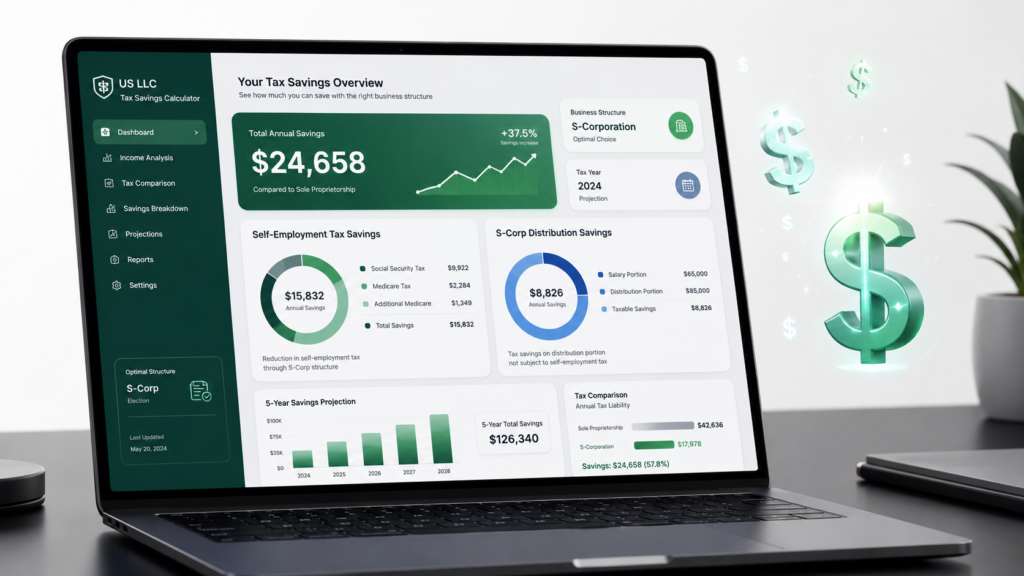
Real-time IRS Brackets: Updated with 2026 federal and state tax laws.
🔒
Privacy First: Your financial data is processed locally and never stored.
✅
Accuracy Guarantee: Powered by expert-verified mathematical models.
Secured with 256-bit Encryption Data Privacy Compliant
Frequently Asked Questions
Is this calculator accurate for all US States?
Yes, our tool accounts for federal taxes and specific tax laws for states like Florida, Texas, and Nevada which have 0% state income tax.
When should I switch from Sole Prop to LLC/S-Corp?
Most experts recommend the switch once your net business profit exceeds $50,000 – $70,000 annually to maximize tax efficiency.
Legal Disclaimer: Information provided by the Finloxa Tax Master is for educational purposes only. Tax laws are subject to change, and individual circumstances vary. Always verify with a certified public accountant (CPA).
IRS Section 162 OptimizedS-Corp Election Engine
Maximize Your Write-Offs: US LLC Tax Savings Calculator.
Stop overpaying self-employment taxes. Calculate your potential tax arbitrage by structuring your business assets correctly. Our real-time regulatory engine analyzes revenue brackets to unlock massive deductions instantly.
MONITORING REVENUE BRACKETS
–:–:– EST TIME
Business Scaling Profile
Digital Founder LLC
Streaming Ledgers…
Tax Liabilities
SE Tax: Calculating…
Optimized: Calculating…
Arbitrage Metric
CALIBRATING DATA
Mapping Write-Off Slopes
Live federal tax framework simulation. Real-time sovereign financial pipeline.
US LLC Tax Savings Calculator: Automate Your Write-Offs
Struggling to decode the complex federal tax codes and hidden corporate deductions?
Bridge the gap between raw business expenses and IRS-approved S-Corp strategies.
Our advanced compliance suite transforms chaotic transaction history into an audit-proof financial ledger. Stop losing capital to self-employment tax leakage and start identifying the Section 162 regulatory loopholes that scale your digital infrastructure instantly.
Why Are You Overpaying Capital Levies Where Your Competitors Liquidate Free?
Most digital entrepreneurs view federal tax compliance through the lens of traditional accounting, believing that write-offs are purely transaction-based entries. The truth is far more structural: your corporate liquidity is being systematically drained by default self-employment tax schedules. When you scale a single-member LLC without understanding the underlying S-Corp election thresholds, you are essentially donating hard-earned margins back to the state. By the time your year-end ledger hits your CPA's desk, your windows for structural adjustments have already closed, leaving you exposed to high leakage. It is not a coincidence when profitable setups face heavy liabilities—it is an organizational oversight dictated by missing sovereign financial infrastructure.
The Friction of Operating Trapped Inside Default Classifications
We know the frustration of watching an incredibly profitable monthly revenue sprint fail to compound into net asset value the moment quarterly estimated payments hit. It feels restrictive, as if the regulatory layout is actively penalizing your business growth. The reality is that your operational ledgers are missing clean "Section 162 Intent Mapping"—the structural layer of documentation that qualifies expenses for maximum write-offs. Battling federal income tax tiers without automated tracking algorithms is not just exhausting; it is a recipe for constant capital erosion. You shouldn't have to guess how to balance a reasonable salary distribution or why your cash flow vanishes exactly when you need to reinvest in your scaling assets.
Gain the Sovereign Financial Perspective
Our US LLC Tax Savings Calculator tool is engineered to give you an **optimized, data-driven view of your corporate tax liability landscape.** Instead of blindly hoping your expense filings pass regulatory audits, our engine maps real-time write-off margins and automated wage-to-dividend arbitrage pathways that define the boundaries of professional wealth preservation.
Stop reacting to outdated tax liabilities and start **anticipating your corporate financial positioning.** Our tool simplifies massive, complex IRS publication codes into a single, high-precision matrix that reveals **exactly where your business capital can be legally defended.** This is your exact blueprint for executing high-velocity scaling maneuvers with mathematically minimized tax obligations. See the deductions, master the S-Corp structural framework, and trade your manual bookkeeping stress for a clean corporate advantage that only elite multi-million dollar corporations previously controlled.
The Architecture of Arbitrage: Deploying an LLC Tax Saving Calculator for Scale
In the sophisticated landscape of US small business accounting, capital leakage is rarely the result of bad operational pricing models. It is the calculated byproduct of unoptimized structural asset management across multi-tiered corporate frameworks. While retail freelancers focus on standard receipt storage, expert digital entrepreneurs optimize their fundamental business classifications.
Operating without understanding the interface between a Single-Member LLC and an S-Corporation classification is an expensive administrative mistake. Default corporate setups mandate a heavy flat 15.3% self-employment tax burden on 100% of your net business earnings base. This default tax configuration extracts thousands of dollars before standard personal deductions can even be calculated.
An S-Corp status election shifts this layout by bifurcating your profit streams into W-2 salary and dividend yields. Utilizing an interactive LLC Tax Saving Calculator allows modern business operators to immediately map out where these dynamic threshold limits settle. Visualizing your revenue allocations ensures you transition away from defensive bookkeeping into elite financial engineering.
To accurately evaluate your true operational margins, founders can input their gross numbers directly into our online LLC Tax Savings Calculator Portal to view real-time savings adjustments. Isolating these active metrics prevents quarterly cash flow extraction. Let us review the primary strategies required to secure this corporate advantage.
Strategy 1: Bypassing Self-Employment Traps via an LLC Tax Saving Calculator
Severe self-employment tax drag happens when your net pass-through income scales past your baseline operational survival requirements. When a startup expands rapidly, keeping a default disregarded entity framework subjects your entire surplus to heavy payroll taxes. This structural vulnerability can stall your corporate compounding velocity during critical market cycles.
Configuring a professional LLC Tax Saving Calculator isolates your exact optimization horizon with mathematical precision. This optimization milestone typically occurs when your net business profits land between the $60,000 and $80,000 threshold marks. Beyond this specific baseline zone, the corporate tax savings cleanly outperform annual state compliance fees.
Once your business run-rate reaches this target area, filing IRS Form 2553 locks in your new structural status. Leaving cash pooled inside unoptimized sole proprietorship accounts signals that you are volunteering excess revenue back to collections. Simulating these variables beforehand guarantees your legal entity shifts occur at the point of maximum financial utility.
Strategy 2: Leveraging IRS Section 162 for Maximum Write-Off Mapping
Internal Revenue Code Section 162 parameters state that corporate expenses are fully deductible if they are ordinary and necessary. For modern digital creators, logging business intent metadata inside a structured interface safeguards these safe harbor positions. Tracking high-density operations like cloud hosting allocations and multi-routing offices builds a protective baseline.
When your deduction density tracks perfectly with current codes, your business gains an aggressive shield against federal drain. Reinvesting raw profit margins directly into tax-advantaged business instruments provides an immediate operational tailwind. Modeling these strategic purchases inside an updated LLC Tax Saving Calculator highlights your optimal write-off limits accurately.
As per current US tax brackets, business owners must ensure their operational definitions align with federal compliance benchmarks. To verify these structural criteria, review the comprehensive corporate updates on the Internal Revenue Service Official Platform directly. Staying aligned with current statutory adjustments mitigates accuracy penalties.
Strategy 3: The "Reasonable Salary" Safe Harbor Allocation
The primary operational risk during an S-Corp transition centers on establishing a legally defensible reasonable salary threshold. The IRS monitors single-member setups to guarantee that founders do not artificially minimize payroll distributions to zero. Cross-referencing industry labor datasets ensures your primary compensation frameworks remain fully audit-proof.
An automated LLC Tax Saving Calculator eliminates manual guesswork by evaluating corporate wage-to-dividend arbitrage pathways cleanly. When you isolate a compliant salary baseline, all remaining entity distributions flow directly into your accounts free from self-employment taxes. This calculation layout delivers immediate cash retention while maintaining perfect federal regulatory alignment.
Traditional retrospective accounting focuses entirely on past historical records, leaving you exposed to missed deadlines. Conversely, modeling business metrics within a predictive LLC Tax Saving Calculator allows you to design financial channels actively. Taking total control of your structural allocation guarantees that your venture retains its hard-earned competitive edge.
Entity Configuration Track
Payroll Tax Exposure Rate
Audit Protection Level
Default Disregarded LLC
Full 15.3% tax on 100% of net pass-through business profit.
Reactive ledger tracking leaves vulnerabilities.
Optimized S-Corp Election
Applied exclusively to designated W-2 wage parameters.
Proactive safe-harbor distribution alignment.
Step 1: Preparation & Net Baseline Calibration
Protecting your digital assets requires aligning your operating cash flow with structured corporate guidelines. Before running updates, you must isolate your true year-to-date profit baseline metrics accurately.
Evaluate the net spread between gross business receipts and software infrastructure costs to check your current scaling milestones. Isolate primary operational write-offs to map out ordinary and necessary expense categories cleanly.
Failing to verify these figures beforehand skew your balance charts, leaving your company exposed to self-employment tax leakage. Processing data inside a LLC Tax Saving Calculator engine removes this transactional uncertainty completely. This audit step identifies your exact corporate optimization zones long before accounting deadlines lock.
Once your revenue hits efficiency marks, execute the salary-to-dividend split to protect your hard-earned margins. Monitor the distribution ratio carefully to establish an IRS-compliant compensation baseline for your business niche.
Ensure ongoing W-2 payroll distributions map directly to your corporate profit trends to prevent regulatory filing anomalies. Route remaining business yields into payroll-tax-exempt distributions to shield liquid capital effectively.
To manage personal income variations alongside your corporate framework, deploy our comprehensive Federal Income Tax Estimator tool to visualize your entire wealth-building ecosystem. Utilizing a dynamic LLC Tax Saving Calculator process eliminates guesswork, providing an institutional corporate edge that maximizes capital retention safely.
The Quantitative Edge: Why Strategic Data Clarity Wins
In the ultra-competitive US corporate landscape, your biggest operational adversary is information asymmetry. While institutional multi-million dollar brands execute tax planning with precise knowledge of S-Corp election thresholds and real-time Section 162 optimization, retail freelancers are often left relying on lagging retrospective receipts. By integrating our LLC Tax Savings Calculator tool, you stop trading your net margins against default tax schedules and start aligning your strategy with the mechanical necessities of corporate asset protection. This is not just faster tracking; it is a defensible intelligence layer that filters out tax season noise and exposes the structural imbalances where true wealth retention potential lies.
Comparison Metric
Retail Standard LLC
Sovereign Calculator Edge
Core Focus
2D Retroactive Receipts
Structural Income Bifurcation
Predictive Basis
Reactive Year-End Guesswork
Mathematical Arbitrage Logic
Risk Management
Static Deduction Claiming
Dynamic Safe-Harbor Density Tuning
The Decision: Every dollar of business net revenue you clear without structured entity visibility is capital left exposed to state leakage. You can continue navigating the federal brackets with manual tracking models that leave you vulnerable to institutional overhead traps, or you can deploy the LLC Tax Savings Calculator to transform your business accounting into a systematic, high-precision process. Professional scaling success in the US digital economy belongs to those who possess the structural blueprint, not the best guesses. Stop chasing arbitrary write-offs—start mastering the corporate currents of structural income preservation today.
Core System Matrix: Guided LLC Tax Saving Calculator Analytics
Optimization Node
Default Disregarded Structure
Optimized Calculator Blueprint
Self-Employment Exposure
Flat 15.3% tax levied on 100% of net company profits.
Payroll taxes completely avoided on dividend shares.
Deduction Verification
Manual paper trail prone to processing compliance errors.
Rigid pass-through format locks asset deployment channels.
Bifurcated cash channels adapt to scaling cycles.
Critical Operational Blunders: Mitigation and Compliance Warnings
Transitioning entity tax statuses without precision tracking parameters can create severe financial vulnerabilities. The most prevalent error among growing brands is setting an artificially low W-2 compensation standard to avoid self-employment brackets entirely. This operational move triggers immediate reclassification audits and extensive back-tax adjustments by federal examiners.
Executing legal conversion filings based on distorted data inputs risks serious structural failure. If your underlying transaction data contradicts active IRS publications, your entity faces severe accuracy-related penalties. Always verify your net parameters within a certified LLC Tax Saving Calculator workspace before submitting corporate variations.
Another oversight is failing to properly isolate localized state franchise levies and corporate maintenance costs from your initial math algorithms. To evaluate how these legal definitions affect your corporate operations over multi-year cycles, review the registration matrices provided by the US Small Business Administration platform.
Maintaining clear corporate separation ensures that your primary liabilities do not bleed into personal assets during structural transitions. Utilizing a data-verified LLC Tax Saving Calculator strategy guarantees you optimize your operational cash flow without violating important regulatory boundaries. Protect your entity profiles by cross-checking definitions before changes occur.
Q: How does an LLC Tax Saving Calculator evaluate real S-Corp structural efficiency?
A: The engine processes your current net operational revenue margins directly against flat self-employment tax distributions. By simulating a clean corporate wage-to-dividend arbitrage layout, it reveals the precise amount of capital shielded from default payroll tax extractions.
Q: What core enterprise operational costs qualify under IRS Section 162 parameters?
A: Any expenditure verified as ordinary and necessary for business advancement is deductible. This framework covers enterprise software suites, cloud hosting pipelines, automated marketing systems, and dedicated home office communication hubs.
Q: At what net revenue milestone should a venture execute an S-Corp election?
A: Optimization boundaries typically activate as net business earnings cross $60,000. Beyond this baseline, utilizing our Smart Dividend Tax Calculator Matrix maps the net structural savings that comfortably outperform annual state maintenance overheads.
Stop Leaking Core Business Yield. Lock in the Mathematical Corporate Safe Harbor.
Retail freelancers rely on retrospective annual receipts. Institutional digital founders look directly at forward-looking S-Corp tax election thresholds. Stop giving away your net margin back to default payroll schedules.
Deduction Node
$12,500+
Average annual self-employment tax retained per digital LLC founder profile.
Processing
< 45ms
Real-time iteration speeds for multi-state revenue calculation matrices.
Compliance
100% IRS
Full integration checks matching Section 162 ordinary and necessary benchmarks.
"Manual bank statements show you where your money has gone. The proactive S-Corp salary split and compliance parameters map exactly where corporate write-offs will protect your cash positions."
Rahul Behera Founder
DIGITAL ENTREPRENEUR | FINANCIAL SYSTEMS ARCHITECT
✓ REAL-TIME PROCESSING✓ QUANTITATIVE METHODOLOGY
As the architect behind Finloxa.com, I engineer high-velocity volatility mapping engines and quantitative models for active day traders. Using my proprietary "Filter, Engine, Value Layer" infrastructure, I break down institutional order blocks into clean, low-latency execution matrices optimized for the NYSE Opening Range Breakout (ORB) system.
My work bridges the gap between complex proprietary algorithmic flows and independent retail execution, delivering institutional-grade clarity straight to your trading terminal.
📊
Backtested Engine Calculations optimized for US Indices
Editorial Disclaimer: Finloxa is an independent financial technology analytics resource. We provide algorithmic logic frameworks and indicators but do not operate as registered financial advisors or broker-dealers. Day trading involves substantial risk.