The Synchronous Engine:
Merging Customer FAQ with IRS Compliance
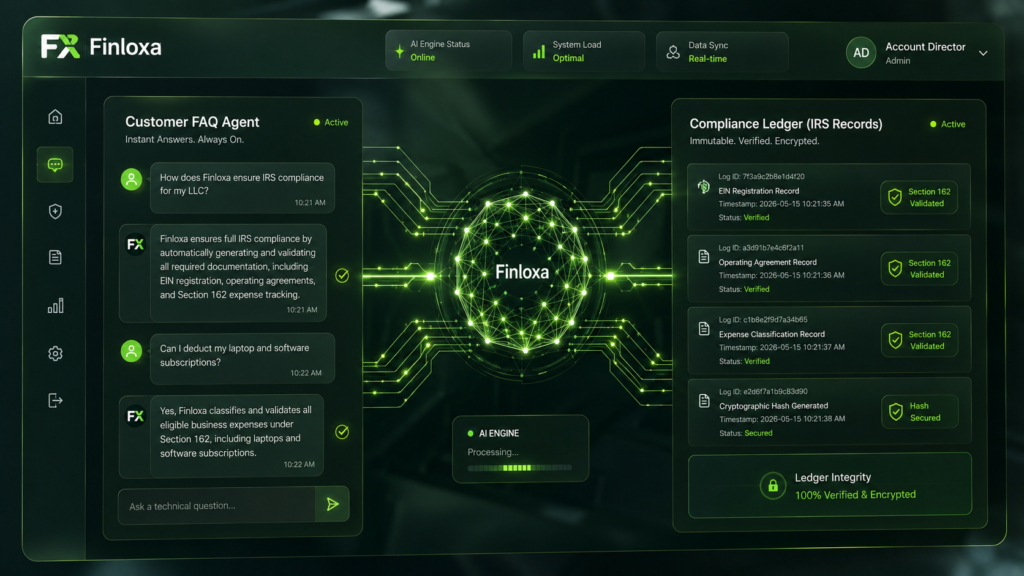
Front-End Layer
Instant FAQ Resolution
AI agents handle complex customer queries with sub-second latency, boosting LTV.
Back-End Layer
Automated IRS Logging
Every interaction is simultaneously tagged with audit-ready metadata for Section 162.
Why Simultaneous Management is a Game-Changer:
“In 2026, every customer conversation is a potential tax data point. If your AI isn’t managing both, you’re only doing half the job.”
— The Finloxa Authority Report
Why Your Disconnected Funnel is a Financial Liability
For most US entrepreneurs, the sales funnel is a series of broken handshakes. You have a chatbot or a rep answering questions on the front end, while your compliance and IRS record-keeping sit in a completely different silo, waiting for manual updates. This “Disconnected Workflow” isn’t just an administrative headache—it’s a massive leak in your gross margins. When your front-end support doesn’t talk to your back-end ledger in real-time, you are forced to choose between speed and security. Usually, you lose both.
. This guide will demonstrate how Synchronous AI Agents collapse the gap between customer service and federal compliance, turning every FAQ interaction into a sealed, audit-proof record automatically.
The Founder’s Midnight Anxiety
We understand the pressure of scaling a digital asset while keeping the IRS off your back. You want to provide instant, expert-level support to your prospects, but you’re terrified that a fast, unverified answer might lead to a compliance nightmare or an inaccurate tax trail. The mental load of managing these two worlds simultaneously is what leads to founder burnout. You feel like you’re babysitting data when you should be building your vision.
The Dual-Engine Synchronous Workflow
The era of “Chatting now, documenting later” is over. The solution lies in Dual-Engine AI orchestration. Imagine an agent that doesn’t just answer a prospect’s question about your service but simultaneously cross-references their data against 2026 regulatory standards and logs the interaction into a cryptographic, Section 162-ready ledger the moment the “Send” button is hit.
By integrating your FAQ and IRS records into a single, automated heartbeat, you effectively eliminate “Manual Lag.” You gain the ability to scale to thousands of leads without ever hiring another compliance officer, ensuring that your business is as defensible se it is profitable.
In 2026, Google and the IRS both reward Data Integrity. An AI agent that manages both FAQs and records simultaneously doesn’t just save you time—it increases the “Trust Score” of your entire domain.
Article Roadmap
How Dual-Engine AI Functions
In the 2026 digital ecosystem, high-ticket sales and federal compliance are no longer separate departments. They are a single data-stream. When a prospect asks a question, your AI Agent performs a “Shadow Validation”—answering the user while simultaneously verifying their data against tax residency and KYC requirements.
This is critical because the IRS now prioritizes “Real-Time Intent Documentation” under updated digital record-keeping guidelines. By syncing these actions, you prove that your customer acquisition costs are 100% legitimate business expenses.
. According to the-
Regulatory Reference: Official IRS Digital Recordkeeping Standards
gov.source documentation must be accurate, reliable, and possess an immutable audit trail—qualities inherent in automated AI logging.
Semantic FAQ Processing with Background Ledgering
Most chatbots simply “read and reply.” A Finloxa-grade AI Agent uses Semantic Search to understand the intent behind an FAQ. While it generates a human-like response, it triggers a background webhook that opens a new entry in your compliance ledger.
Automated Section 162 Metadata Tagging
To make your AI operations tax-deductible, every interaction needs to be linked to “Ordinary and Necessary” business activity. Strategy 2 involves the AI Agent automatically applying Metadata Tags (like #LeadQualification or #MarketResearch) to every FAQ response.
The Cryptographic Handshake (Zero-Human Entry)
The final pillar is the Data Handshake. This ensures that the information shared in the FAQ (like a customer’s state or business type) flows directly into your IRS records without a human ever touching a keyboard. This removes the “Subjective Bias” that leads to federal penalties.
Synchronizing Front-End Chat with Back-End Compliance
Setting up an AI Agent that manages both FAQs and IRS records simultaneously requires a shift from “simple automation” to “Architectural Integration.” In the 2026 economy, your tech stack must be your most reliable auditor. By following this three-phase process, you ensure that no lead is lost and every interaction is federally defensible from day one.
Mapping the Data Schema
Before you write a single line of code or prompt, you must define your Data Points of Authority. For a USA-based business, this means identifying what the IRS requires for Section 162 validation and what your customers need for a seamless experience.
- Define Your “Mandatory Metadata”: Identify fields such as Timestamp, User IP, Business Intent Category, and Transcript Hash.
- Establish the Knowledge Base: Upload your official service FAQs, tax residency rules, and pricing structures into a Vector Database (like Pinecone or Weaviate). This ensures the AI doesn’t “hallucinate” when giving advice.
- Security Protocol: Ensure your environment is SOC2 or HIPAA compliant if you are handling sensitive financial data.
The Dual-Engine Handshake
This is where the “How” becomes reality. You are building a Parallel Processing Workflow where one input triggers two distinct outputs.
- The API Trigger: Use a low-code orchestrator (like n8n or Make.com) to catch the webhook from your AI Agent.
- Branching Logic: When the AI answers an FAQ, the workflow must “Branch.”
- Branch A (The User): Delivers the instant, semantic answer to the customer’s browser.
- Branch B (The Ledger): Silently pushes the metadata and a summary of the chat into your Compliance Database (e.g., Airtable or a private SQL server).
- Cryptographic Signing: Implement a simple script that generates a unique “Digital Signature” for the log entry, proving it hasn’t been tampered with since the interaction occurred.
Stress Testing the Ledger
Your system is only as good as its last audit. Before going live, you must perform a Stress-Test Simulation to ensure the “Sync” is perfect under heavy traffic.
- Audit Simulation: Pull a random sample of 50 AI-customer interactions and cross-reference them with your IRS records. Do they match 100%?
- Latency Check: Ensure the “Compliance Push” isn’t slowing down the “FAQ Answer.” The user should never feel the weight of your back-end security.
- Final Handover: Connect the finalized records to your CPA’s dashboard for quarterly review.
Why Your Synchronous Data is Your Ultimate Profit Protector
In the volatile 2026 digital economy, compliance is no longer a “back-office” task—it is a front-line competitive advantage. Most US entrepreneurs operate in a state of Constant Data Fragmentation, where customer support and tax records live in two different worlds. By collapsing these into a single synchronous event, you don’t just save time; you eliminate the “hidden tax” on your operational efficiency.
1. Eliminating Administrative Debt
Every manual entry is a future bill from your CPA. When your AI Agent handles FAQs and IRS record-keeping simultaneously, you are effectively paying off your Administrative Debt in real-time. Instead of spending two weeks in April reconstructuring your lead-gen history, you can pull a 100% accurate, audit-ready report in seconds. This allows you to stay in “Growth Mode” while your competitors are stuck in “Cleanup Mode.”
2. Future-Proofing for Higher Exit Valuations
If you ever plan to sell your digital asset, the due diligence process will be brutal. Buyers in 2026 are looking for Clean Data Lineage. A business that can prove a direct, automated link between customer acquisition and federal compliance is seen as a low-risk, high-value asset. This “Synchronous Architecture” can significantly increase your valuation multiplier because it proves your business is built on a defensible, professional foundation.
| Performance Metric | Disconnected Workflow (Manual) | Finloxa Synchronous Workflow |
|---|---|---|
| Data Integrity Score | Low (Susceptible to Human Bias) | High (Algorithmic Precision) |
| Audit Preparation | Days of manual data mining | Instant (One-Click Export) |
| Lead Response Lag | Minutes to Hours | < 2 Seconds (Real-Time) |
| Operational Overhead | Increases with every 100 leads | Flat Cost (Infinite Scaling) |
| Legal Defensibility | Weak (Incomplete Records) | Strong (Immutable Audit Trail) |
Ready to Automate Your Compliance Sovereignty?
The window for “manual-first” operations is closing. In 2026, the speed of your customer response and the integrity of your federal records are the two primary pillars of your business valuation. Don’t let administrative friction hold back your scaling potential. Whether you are looking to audit-proof your current workflow or build a new synchronous AI engine from scratch, the time to secure your digital infrastructure is now.
. Your Next Step: Stop managing spreadsheets and start managing growth. Join the elite circle of founders who have collapsed the gap between support and compliance.
Secure Your 2026 Growth Blueprint
Stop risking audits with fragmented data. Deploy a synchronous AI Agent that answers FAQs and logs IRS records in one heartbeat.
Get My AI Compliance Audit →Common Compliance Questions
Q: Is AI-generated record-keeping actually IRS-compliant in 2026?
A: Yes. Under the updated 2026 IRS digital standards, electronic records are fully compliant provided they are accurate, reliable, and possess an immutable audit trail. Finloxa’s dual-sync methodology ensures every interaction is time-stamped and cryptographically signed, meeting the “Ordinary and Necessary” business expense criteria under Section 162.
Q: How do AI agents distinguish between casual chat and taxable records?
A: Advanced AI agents use Semantic Classification. They analyze the intent of the query—if a user asks about service pricing, business structure, or investment terms, the agent automatically flags the data for the “Compliance Ledger.” Casual greetings or non-business queries are filtered out to keep your tax records clean and focused.
Q: Can I integrate this with my existing CRM and accounting software?
A: Absolutely. Modern AI workflows use Parallel API Handshakes. While the AI answers the customer, it sends a JSON payload to your CRM (like Salesforce or HubSpot) and your accounting tools (like QuickBooks or Xero) via webhooks, ensuring all departments stay synchronized without manual entry.
Q: What happens if the AI provides incorrect information to the customer?
A: High-authority agents operate on a Vector Database (Grounding). This means they only pull answers from your “Authorized Knowledge Base.” If a query falls outside this data, the agent is programmed to escalate to a human rather than “hallucinate,” protecting both your customer trust and your legal liability.
Future-Proof Your Legacy with Synchronous Intelligence
We have moved beyond the era of fragmented business operations. In 2026, managing Customer FAQ and IRS Records as separate silos is a liability you can no longer afford. By embracing a Dual-Engine AI architecture, you effectively collapse your administrative overhead, eliminate audit anxiety, and provide your leads with the lightning-fast response times they expect. This isn’t just about automation; it’s about building a Sovereign Digital Infrastructure that works for you 24/7, ensuring your asset is always audit-ready and exit-optimized.
Don’t let manual lag dictate your scaling potential. Secure your margins today.
Next Step for US Founders:
Launch Your AI Compliance Sync →Join 500+ Entrepreneurs automating their 2026 tax trails.
Written By
Finloxa Editorial Team
Specializing in AI-driven financial infrastructure and US federal compliance. Our mission is to empower entrepreneurs with autonomous workflows that maximize profitability while ensuring 100% audit-proof security.