The Autonomous Business Protocol:
Mastering Workflow Automation
with AI
The Automation Mandate
In the modern digital economy, the most significant bottleneck to scaling is not a lack of opportunity—it is the sheer exhaustion of manual operational tasks. For entrepreneurs and high-ticket affiliates, the “hustle” model of manually managing lead flow, email nurturing, and content scheduling is no longer a viable path to 7-figure operations. In 2026, the competitive advantage belongs to those who view business not as a series of chores, but as a system of interconnected workflows.
Automation is no longer a luxury; it is the infrastructure of professional scalability. By integrating the logical power of n8n with the generative intelligence of ChatGPT, you can effectively hand off 80% of your repetitive business tasks to an autonomous engine. This doesn’t just save time; it eliminates human latency, ensures consistency in your communication, and allows you to focus your intellectual energy on high-level strategy—the only work that actually drives growth.
This protocol is designed to transition you from an operator to an architect. We will move beyond basic “if-this-then-that” sequences and build sophisticated, self-correcting systems that handle everything from qualified lead routing to dynamic content distribution. Whether you are running a financial utility or a complex affiliate funnel, the ability to automate your operations is what separates a chaotic side-hustle from a sustainable, high-authority digital entity. It is time to stop working in your business and start working on its architecture.
Protocol Roadmap
01. Mapping Operational Bottlenecks
Strategic Audit & Logic Definition
The primary failure of most automation attempts is not the technology—it is a misunderstanding of the process itself. Before a single node is placed in n8n, you must conduct a surgical audit of your operations. Identify the tasks that are “deterministic”—those governed by fixed rules—and those that are “generative,” requiring human-like judgment. Automation should only be applied to tasks that are repeatable, rule-based, and high-frequency. If a process is chaotic, automating it will only produce chaos at scale.
Your objective here is to map the entire lifecycle of a task: the trigger, the data source, the transformation logic, and the final destination. By documenting these flows, you transform hidden bottlenecks into transparent engineering challenges. Remember, if you cannot diagram the process on a whiteboard, you cannot automate it. This phase is about stripping away the inefficiency to expose the core logic, ensuring that your future automated infrastructure is built on a foundation of operational clarity rather than assumed shortcuts.
02. Architecting n8n Workflow Logic
Building the Execution Backbone
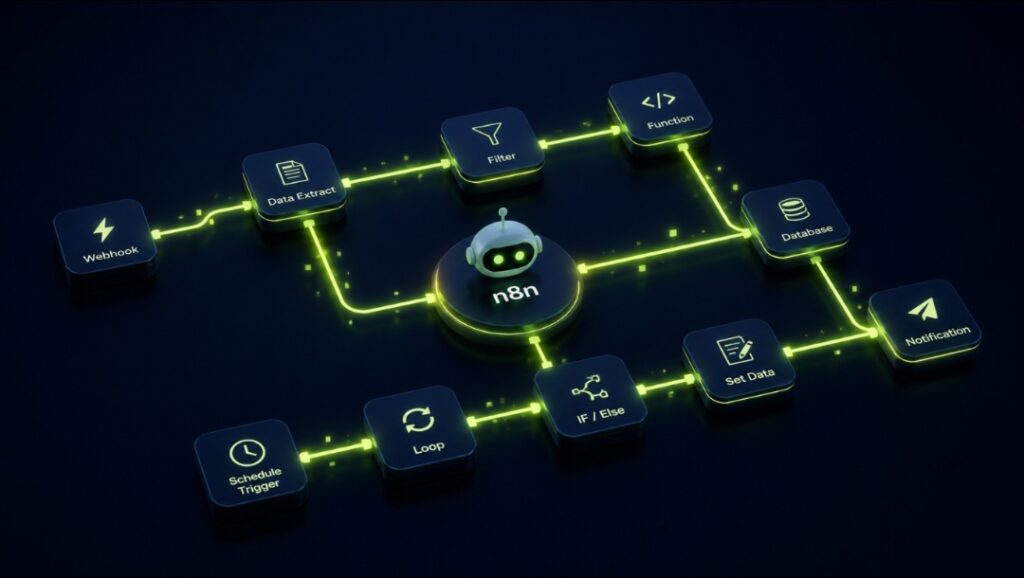
With the bottleneck identified, the next phase is to architect the logic within n8n. Think of n8n not just as an automation tool, but as the digital nervous system of your business. Your workflow architecture should be modular, clean, and highly readable. Use webhooks to trigger actions in real-time, ensuring that data moves seamlessly between your front-end systems (like a website form or email) and your back-end engines.
Focus on “Conditional Routing”—using IF/ELSE nodes to direct data paths based on specific criteria. For example, a lead with a high-intent score should be routed to a personalized sales sequence, while a general inquiry goes to a standard educational drip. By designing your backbone with “Sub-workflows,” you keep the main logic simplified and easy to debug. Professional engineering requires that your workflows are not monolithic; they should be a series of interconnected, specialized nodes that can be independently updated, tested, and scaled. This modularity is the hallmark of a resilient, enterprise-grade automation architecture.
03. Injecting ChatGPT Intelligence
Integrating Cognitive AI Nodes
The shift from simple automation to an “Autonomous Business” occurs at the point of AI integration. By injecting ChatGPT via OpenAI API nodes into your n8n workflows, you provide your business with the ability to interpret, synthesize, and create content on-the-fly. This is where “deterministic” tasks become “cognitive.” For instance, rather than simply routing an email to a folder, your system can now parse the message, analyze the sentiment, draft a personalized, high-value response, and update your CRM—all in seconds.
The key to success is in your “System Prompting.” Don’t treat the AI as a generic chatbot; give it a specific role, a tone, and clear constraints. Your API nodes should handle complex tasks such as data extraction from unstructured text, customer objection handling, and even the generation of personalized outreach content based on specific lead data. This integration turns your business into a self-learning system that handles high-level cognitive tasks autonomously, allowing you to focus on the strategic outcomes rather than the tactical output.
04. Resilience & Error Handling
Fail-Safe Automation Protocols
A “Professional” system is defined not by how it behaves under normal conditions, but by how it handles failure. API outages, token limit exhaustion, and invalid data formats are inevitable. Your architecture must incorporate robust error-handling protocols to ensure system resilience. Use “Error Trigger” nodes to catch failures instantly and alert you via Slack or email with a detailed log of the issue.
Implement “Retry Logic” for transient network failures and “Validation Nodes” to ensure that the data being passed from one system to another is in the correct format. If a critical process fails, your system should be intelligent enough to pause, notify, and wait for human intervention—or, if configured, roll back to a known stable state. A professional-grade automation setup is self-healing, preventing data loss and ensuring that your core operations never experience a total blackout. This commitment to resilience is what differentiates a high-authority business asset from a brittle, breakable side-project.
05. Monitoring & Versioning
Continuous System Optimization
Automation is never “set and forget.” It requires continuous monitoring and systematic versioning. As your business grows, your processes will change, and your workflows must evolve to accommodate that growth. Use the n8n execution logs to track performance metrics—latency, error rates, and success ratios. If a specific section of your workflow is consistently slow, it is time for a code optimization or a logic overhaul.
Implement a strict version control protocol. Before making changes to a live workflow, duplicate it to test in a sandbox environment. Document every update, including the “why” and “how” of the changes. This provides you with an audit trail that is invaluable for troubleshooting and compliance. Continuous optimization is the process of shaving milliseconds off execution times and refining your prompts for better AI-generated output. By treating your automation engine as a living software product that requires regular maintenance and iteration, you ensure that your business remains agile, efficient, and technologically superior to competitors relying on stagnant, manual processes.
The Autonomous Execution Workflow
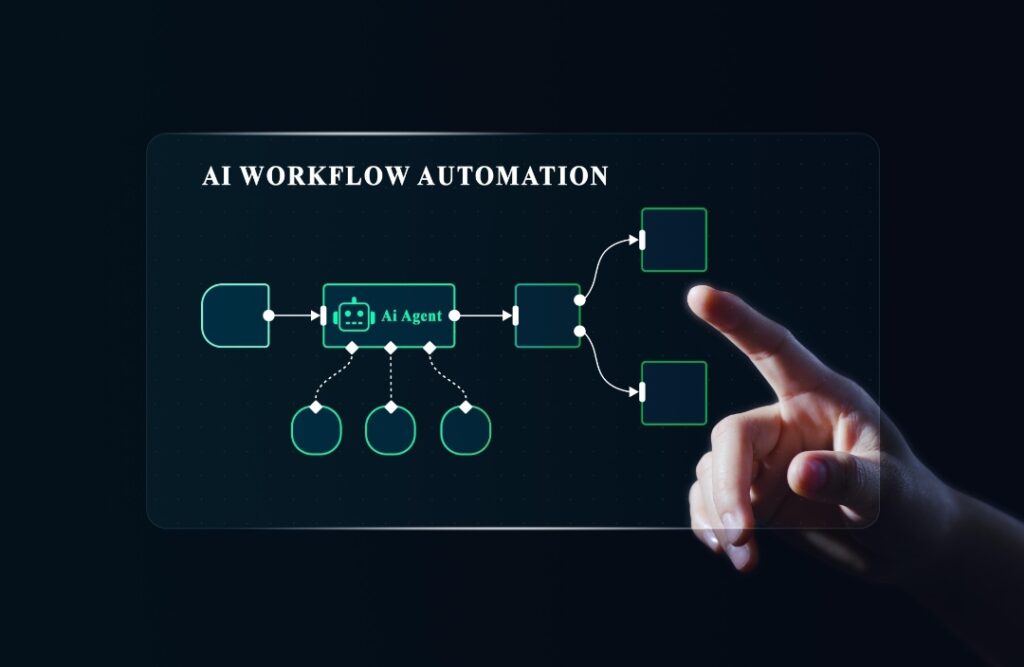
Transitioning your business to an autonomous model is not a single event; it is a phased deployment of intelligent infrastructure. To move from manual labor to an “autonomous state,” you must implement the following 6-step protocol. This framework is designed to prioritize data integrity and system scalability, ensuring that your AI-driven engine remains stable as your volume increases.
The Autonomous Execution Protocol
The Architect’s Mindset
This protocol functions as the “operating system” for your business. By following these six steps, you stop managing tasks and start managing systems. The goal is to build an ecosystem where the manual “click-work” is effectively zero. When you automate the repetitive operational tasks—from data routing to lead communication—you reclaim your most valuable asset: your ability to execute strategy. This is not about removing the human element; it is about elevating the human element from the mundane to the strategic. Once the engine is active, your role transforms from “Operator” to “System Architect,” ensuring the business continues to grow, iterate, and generate value while you focus on high-level direction.
The Automation Advantage: Manual vs. Autonomous Operations
For the digital entrepreneur, the transition from manual task management to an autonomous business model is the single most significant factor in achieving exponential growth. In 2026, the market rewards speed, consistency, and data-driven precision—qualities that are inherently compromised when humans attempt to handle high-frequency operational tasks. By implementing the Autonomous Business Protocol, you are not merely “using tools”; you are building a scalable revenue engine that operates with 24/7 consistency.
| Feature | Manual Operations | Autonomous Protocol |
|---|---|---|
| Execution Speed | Human-latency (Minutes/Hours) | Instant (Milliseconds) |
| Task Consistency | Variable (Prone to fatigue) | Absolute (100% precision) |
| Data Integrity | High risk of manual error | Validated (Schema-enforced) |
| Scalability | Linear (Requires more staff) | Exponential (Zero marginal cost) |
| Strategic Focus | Tactical execution | Architectural design |
Why Autonomous Systems Win
The comparative advantage of an autonomous system lies in Strategic Reallocation. When you rely on manual operations, your cognitive capacity is consumed by the “mechanical” aspects of business—data entry, lead nurturing, and content routing. This is “low-leverage” work. Conversely, an autonomous engine handles the mechanical load, freeing you to operate as a “System Architect.”
This shift changes the economics of your business. You no longer need to hire additional operational staff to handle volume spikes; your workflow logic simply executes at scale without degradation. Furthermore, your data integrity increases significantly. Human error is removed from the equation, ensuring that every lead is routed, tagged, and nurtured exactly according to your business logic. In 2026, the competitive edge belongs to the entrepreneur who treats their business as a software entity, utilizing automation not as a convenience, but as a core competitive barrier to entry.
Ready to Build Your Autonomous Business?
Stop the cycle of manual “click-work.” Access our pre-built n8n workflow templates, OpenAI integration prompts, and fail-safe error handling protocols used to scale high-authority digital entities.
Includes verified 2026 n8n + ChatGPT integration templates. View system performance stats →
Automation Architecture FAQs
Expert clarity on AI-driven workflows.
Q. How does n8n compare to SaaS-based automation tools like Zapier?
n8n offers a “node-based” workflow design that provides significantly more granular control and data privacy compared to standard SaaS tools. Because you can self-host n8n, you are not subject to the same execution limits or per-task pricing models, making it the superior choice for high-volume, enterprise-grade automation architectures that require complex logic branching.
Q. What is the role of ChatGPT in an automated workflow?
ChatGPT acts as the “Cognitive Engine” within your workflow. While standard automation nodes perform deterministic tasks (like data movement), ChatGPT nodes interpret unstructured data—such as customer inquiries, sentiment analysis, or document summarization—and generate contextually relevant, human-like outputs in real-time. It essentially allows your business to “think” and respond to triggers autonomously.
Q. Can an autonomous system handle complex business tasks?
Yes, provided the task is mapped into distinct, rule-based logic steps. By breaking down complex tasks into a series of modular n8n workflows, you can automate almost any process that does not require physical interaction. From high-ticket lead qualification to dynamic content generation, complex systems thrive on modularity and rigorous error-handling protocols.
Q. How do I prevent API errors from breaking my business?
Resilience is built through fail-safe protocols. Professional architects utilize “Error Trigger” nodes to catch API timeouts or schema mismatches in real-time. By implementing retry logic, data validation steps, and automated alerts for human intervention, you ensure that your automation engine remains stable even when external services face intermittent connectivity issues.
The Strategic Verdict
Building an autonomous business engine is not merely about convenience; it is a fundamental shift toward operational sovereignty. Throughout this protocol, we have moved beyond basic task automation to address the core mechanics of system architecture: intent-based logic, cognitive AI integration, and fail-safe resilience. In the 2026 digital landscape, the distinction between a scaling entity and a chaotic side-hustle is defined by this single metric—how much of your operation functions without human intervention. By deploying n8n and ChatGPT as a unified engine, you stop trading your time for operational upkeep and start scaling a high-performance asset. Your business is a software entity; treat it with the technical rigor of a Silicon Valley startup. With these protocols, you have the roadmap to achieve total operational efficiency. Execute with precision, iterate based on performance logs, and secure your place at the forefront of the AI-driven economy.
Finloxa | 2026 Autonomous Business Architecture Protocol
Finloxa Strategy Lab
Verified 2026 AI Automation Architecture
Finloxa is a specialized research hub for digital entrepreneurs focused on high-performance scaling. Our protocols synthesize complex US market data, enterprise-grade automation logic, and cognitive AI workflows into actionable systems. We empower creators to transform ambitious ideas into professional, autonomous digital assets. Our mission is to provide the architectural clarity required to operate at scale, ensuring our partners achieve sustainable growth through data-backed, high-authority systems.