How to Start a Wyoming LLC
as a
Non-Resident: Privacy, Taxes,
and Setup Blueprint
(And How Much You’ll Actually Save in Taxes)
The Core Requirements for Non-Resident Founders
Navigating the US legal landscape as a non-resident might seem daunting, but when you strip away the bureaucratic noise, the actual requirements for establishing a Wyoming LLC are remarkably streamlined. You do not need to be a US citizen, nor do you need to hold a visa, to own a thriving American business entity. The infrastructure is designed to facilitate global capital, provided you have the right documentation in place.
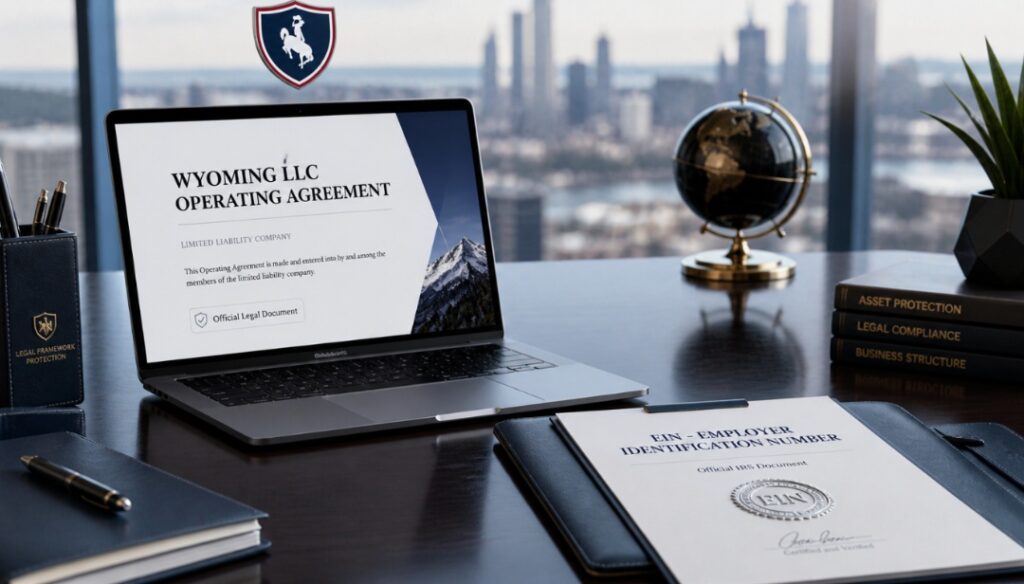
The foundational trio for your setup includes the Registered Agent, the Operating Agreement, and the Employer Identification Number (EIN). A Registered Agent is a mandatory legal representative based in Wyoming who acts as the primary point of contact for government communications. Think of them as your business’s legal “anchor” in the state, ensuring that any official notices or service of process reach you instantly, regardless of where you are located globally.
The Operating Agreement serves as your company’s internal constitution. While Wyoming law does not strictly mandate filing this document with the state, it is indispensable for non-residents. It outlines the governance structure, roles, and protection mechanisms for the members. This document is what differentiates a “hobby” from a legitimate, investable business entity. It provides the legal clarity necessary for opening US bank accounts and entering into vendor contracts.
Finally, the EIN functions as your business’s “Social Security Number.” Issued by the IRS, this number is the key to unlocking the US financial system. It allows you to pay taxes, hire employees, and—most crucially—open a business bank account without needing a personal US bank account. Securing these three components effectively completes your “digital infrastructure,” allowing you to operate your business from anywhere in the world with total regulatory confidence.
Guide Roadmap
01. Entity Filing & Registered Agent
Establishing Your Wyoming Foundation
The journey to building a legitimate US business entity begins with your “Articles of Organization.” This is the foundational legal document filed with the Wyoming Secretary of State. For a non-resident founder, the most critical element here is the appointment of a Registered Agent. A Registered Agent is not just a formality; they are the legal backbone of your presence in the state, serving as the official liaison between your business and the Wyoming government.
Choosing a reputable Registered Agent ensures that any critical legal correspondence, such as service of process or official government notices, is handled with absolute confidentiality and speed. By design, Wyoming’s filing process is exceptionally business-friendly, allowing you to establish your entity without the heavy bureaucracy found in states like California or New York. The system is built for speed and anonymity, ensuring your personal identity remains shielded from public view while your business entity gains formal recognition. Think of this phase as laying the concrete slab for a skyscraper; it must be perfectly level and compliant, as everything you build in the future—your brand, your assets, and your financial freedom—will rest upon this foundation.
02. IRS Gateway: Securing Your EIN
Unlocking US Financial Systems
Once your LLC is registered with the state, your next technical milestone is securing an Employer Identification Number (EIN) from the IRS. Think of an EIN as the Social Security Number for your business. It is the primary credential that unlocks the US financial system, enabling you to open business bank accounts, hire independent contractors, and fulfill your tax filing obligations.
For non-residents without a Social Security Number (SSN) or Individual Taxpayer Identification Number (ITIN), the process can seem intimidating, but it is entirely manageable with the correct filing of Form SS-4. This is where your Registered Agent’s expertise often pays dividends, guiding you through the IRS requirements specifically tailored for foreign-owned entities. An EIN effectively “activates” your business in the eyes of the US government, moving it from a dormant state-registered entity to an active, operational business capable of commerce. This is the single most important asset you will secure. Without a verified EIN, you remain effectively invisible to the US banking infrastructure, so approach this phase with precision and ensure all data points on your application are flawlessly aligned with your Articles of Organization.
03. The Governance Shield
Drafting Your Operating Agreement
An Operating Agreement is your company’s internal “Constitution.” While Wyoming law does not mandate filing this document with the Secretary of State, treating it as optional is a beginner’s mistake. For non-resident founders, the Operating Agreement is your primary legal “Governance Shield.” It explicitly details the ownership structure, the decision-making processes, and the specific protections for members, ensuring that your LLC operates as a distinct legal personality separate from your personal life.
In the event of a legal dispute or an audit, the Operating Agreement serves as the definitive evidence of your business’s legitimacy. It is frequently requested by US banks, payment processors, and vendors as part of their “Know Your Business” (KYB) requirements. By drafting a comprehensive agreement that includes robust asset protection clauses, you aren’t just checking a box; you are architecting a protective barrier. A well-crafted agreement prevents potential conflicts and clarifies the rules of the road for how capital is managed and how decisions are made. In the world of high-ticket entrepreneurship, your Operating Agreement is the document that provides the “corporate veil” necessary to protect your personal assets from the liabilities of your business.
04. US Business Banking
Building Financial Infrastructure
With your EIN in hand, you must now establish a dedicated US business bank account. This is the stage where “legal entity” meets “liquidity.” For non-residents, the landscape has evolved significantly in 2026. Traditional brick-and-mortar banks are often inaccessible for remote founders, but the rise of digital-first financial institutions like Mercury, Relay, and Airwallex has transformed the game. These platforms are designed specifically for global founders who operate their companies remotely.
The goal here is to create a clean, distinct financial perimeter between your personal income and your business revenue. Mixing personal and business finances is the fastest way to “pierce the corporate veil,” which puts your limited liability protections at risk. When selecting your banking partner, prioritize platforms that offer seamless API integrations with your accounting software and robust fraud protection. Your US bank account is the heartbeat of your operations—it is where your affiliate revenue will land and where your business expenses will be managed. Having a professional, FDIC-insured business account adds an immediate layer of credibility to your venture, signaling to vendors and customers alike that you are a serious, legitimate operation capable of handling professional-grade financial transactions.
05. Compliance & Maintenance
2026 Regulatory Lifecycle
Establishing your Wyoming LLC is only the first act; the second act is maintaining its “Good Standing” through diligent annual compliance. Wyoming’s regulatory requirements are minimal, but they are unforgiving if ignored. Every year, you are required to file an Annual Report and pay a modest franchise tax to the state. These filings are the government’s way of verifying that your business is still active and that your contact information remains accurate.
In 2026, the regulatory environment is becoming more automated, yet the stakes remain high. Failure to file your annual report by the due date will lead to the administrative dissolution of your LLC, effectively stripping away all your privacy and liability protections. This is where a proactive mindset is required. We recommend automating your annual filing reminders to ensure this maintenance task never slips through the cracks. Beyond the state-level requirements, you must also keep your internal records—such as updated member lists and meeting minutes—organized in a secure, digital repository. By treating your compliance as a high-priority operational task rather than an afterthought, you protect the integrity of your business asset. A well-maintained LLC is a permanent, scalable vehicle for your wealth, while a neglected one is merely a liability waiting to surface.
The 5-Phase Formation Protocol
Why This Protocol Defines the 2026 Winner:
Professional formation is built on precision. Amateurs treat formation as a document-filling exercise, which often leads to errors that can dissolve an LLC months later. A high-ticket entrepreneur treats formation as an engineering task. By following this 5-phase protocol, you are not just registering a business name; you are building a resilient, investable asset. You are eliminating legal “single points of failure” that typically plague remote founders. When your foundation is this robust, the IRS and banking institutions view your business as low-risk, which dramatically accelerates your ability to scale revenue, access merchant services, and protect your hard-earned profits. In the global economy of 2026, those who build on a foundation of professional protocols don’t just survive—they scale.
Why Wyoming Outperforms Other Jurisdictions
For the global founder, the choice of jurisdiction is the most impactful decision in your business lifecycle. While Delaware has historically dominated the US corporate narrative, Wyoming offers a significantly higher ROI for remote entrepreneurs, digital creators, and small-to-medium enterprise (SME) owners. The following comparison highlights why Wyoming is the architect’s choice for 2026.
The Comparative Edge
| Feature | Wyoming LLC | Delaware LLC | Home-Country |
|---|---|---|---|
| State Income Tax | 0% | Dependent on nexus | Varies (Often High) |
| Privacy Protection | High (Anonymous) | Moderate | Low |
| Annual Fees | Low ($60 avg) | Moderate ($300) | Varies |
| Asset Protection | Strong (Charging Order) | Strong | Weak to Moderate |
| Maintenance | Minimalist | High Burden | High |
The Strategic Advantage
The primary difference lies in the administrative friction. Delaware is optimized for venture capital-backed startups that require complex equity structuring and board-governed bylaws. If you are building a service-based business, a content empire, or an affiliate network, Delaware’s administrative requirements (such as the franchise tax and complex reporting) are unnecessary overhead.
Wyoming, conversely, is built for the “Lean Entrepreneur.” It minimizes the compliance drag that kills momentum for solo founders. By choosing Wyoming, you aren’t just saving on annual fees; you are reclaiming hours of labor that would otherwise be spent on redundant filings. Furthermore, Wyoming’s “Charging Order” protection ensures that your business assets are shielded from personal legal claims—a feature that provides peace of mind when operating across borders.
Ultimately, your entity should act as a catalyst, not a tax on your productivity. Wyoming provides the exact legal infrastructure required to operate in the US market with anonymity, efficiency, and zero state-level tax liability, allowing you to focus strictly on revenue generation and asset acquisition.
Ready to Launch Your US Entity?
Stop over-complicating the formation process. Access our verified workflow to secure your Registered Agent, EIN, and Operating Agreement in 72 hours.
Includes 2026 compliant templates. View success stories →
Wyoming LLC FAQs
Expert answers for global founders.
Q. Do I need to be a US citizen to start a Wyoming LLC?
No. The United States allows non-residents, regardless of citizenship or physical location, to own and operate a US-based LLC. You do not need a US visa, a Social Security Number (SSN), or a physical presence in Wyoming to legally form and manage your business.
Q. Is my personal name public in Wyoming?
One of Wyoming’s primary benefits is anonymity. When you use a professional Registered Agent, their name and address are listed on the public Articles of Organization, effectively keeping your personal identity off the state’s public registry.
Q. Will I owe US taxes as a non-resident?
Wyoming charges zero state corporate income tax. However, you may still be liable for Federal US taxes depending on your “Effectively Connected Income” (ECI). It is highly recommended to consult a tax professional specializing in international business to ensure proper classification of your income.
Q. Can I open a US bank account from abroad?
Yes. Once you have an EIN and your formation documents, digital-first banks like Mercury or Relay are optimized to accept non-resident founders. They offer online application processes that verify your business legitimacy and provide a fully functional US banking infrastructure.
Building Your Global Asset
Starting a Wyoming LLC is not merely a legal filing; it is the definitive moment you transition from a freelance operator to a global business owner. By choosing this jurisdiction, you have secured the same level of asset protection, privacy, and tax efficiency favored by the world’s most successful entrepreneurs. The infrastructure is now in place, the path is clear, and the tools are at your disposal. Remember, in 2026, the competitive advantage belongs to those who act with precision and build systems that require minimal maintenance. Your LLC is now your permanent legal vehicle—a robust, scalable vessel designed to hold your revenue, protect your interests, and facilitate your expansion into the US market. You have completed the foundation. Now, it is time to build the empire. The structure is yours; your legacy begins with the execution.
Finloxa | 2026 US Business Formation Protocol
Verified by Finloxa Strategy Team
2026 Regulatory Compliance Dept.
This guide is curated by Finloxa’s legal-strategy specialists, focusing on US business formation for international entrepreneurs. We cross-reference IRS guidelines, Wyoming Secretary of State mandates, and 2026 tax protocols to ensure our blueprints remain the industry standard for non-resident compliance.
Trust Factor: Our strategies are built on real-world asset protection data, designed to minimize bureaucratic overhead while maximizing operational privacy for high-ticket digital assets.