The Algorithmic Edge:
A Beginner’s Guide to
Deploying AI Trading Bots
for Smarter Market Entry
(How to automate your entries with precision)
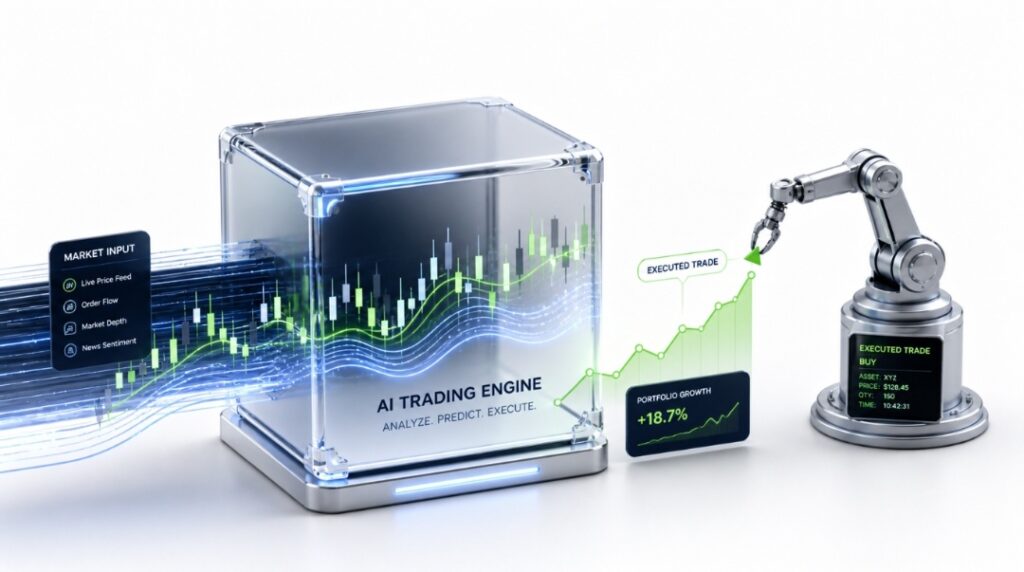
The Systematic Shift: Why Manual Trading is Becoming Obsolete
For decades, the image of a successful trader was a person glued to a monitor, frantically reacting to ticker-tape fluctuations and market news. But in 2026, that manual approach is rapidly becoming a relic of the past. As retail investors gain access to sophisticated, high-speed execution tools, the bottleneck has shifted from information access to execution speed and emotional discipline. If your strategy relies on your ability to manually click “buy” or “sell” at the exact second a trend emerges, you are fighting a losing battle against latency and human cognitive bias.
Enter the era of Systematic Trading. By offloading entry and exit decisions to AI-driven trading bots, you transition from an reactive participant to an architect of market systems. These bots do not experience “fear of missing out” (FOMO), nor do they hesitate when a technical indicator aligns. They operate with mathematical precision, executing trades based strictly on the parameters you define.
This transition is not about surrendering control to an “AI black box.” On the contrary, it is about gaining professional-grade oversight. By deploying bots, you are encoding your specific risk-reward philosophy into an automated workflow, ensuring that your strategy is executed consistently across every trade. In this guide, we break down the mechanics of these systems, showing you how to move beyond basic automation toward a disciplined, data-backed approach to market entry.
The Trading Roadmap
01. Anatomy of a Trading Bot
From Indicators to Execution
At its core, an AI trading bot is simply a set of logical rules acting on market data. Unlike a human trader who might hesitate due to market noise or emotional fatigue, a bot functions strictly on the parameters defined by its code. It continuously ingests real-time price feeds and processes them through technical indicators—such as Moving Averages (MA), Relative Strength Index (RSI), or Bollinger Bands—to identify specific trading setups.
When your pre-defined conditions are met (e.g., “If the 50-day EMA crosses above the 200-day EMA, and RSI is below 40, initiate a Buy order”), the bot triggers an execution command to your broker via an API. The true “anatomy” involves three layers: the Data Layer (fetching price/volume), the Logic Layer (the mathematical rules), and the Execution Layer (API communication with your broker). The advantage here is pure speed and, more importantly, logical consistency. By removing the “human element” from the execution phase, you ensure that your strategy is applied exactly as you intended, every single time, without the cognitive biases that often lead to poor entries or missed opportunities.
02. Backtesting
The Non-Negotiable Foundation
Before you deploy a single dollar of capital into a live market, you must prove your strategy’s viability through rigorous backtesting. Backtesting involves running your algorithmic logic against historical market data to see how it would have performed. This is your primary defense against “curve-fitting”—the dangerous practice of creating a strategy that works perfectly on past data but fails in real-time.
To perform professional-grade backtesting, you should look for metrics beyond just “total profit.” Analyze the Drawdown (the peak-to-trough decline in your capital), the Sharpe Ratio (risk-adjusted returns), and the Win/Loss Ratio. If your bot shows an incredible return on historical data but carries a 40% maximum drawdown, it is likely too volatile for sustainable growth. In the 2026 market environment, professional traders use “Walk-Forward Analysis,” which optimizes the strategy on one set of data and then validates it on an entirely new, unseen set. This process filters out luck, ensuring that your bot is built on a foundation of repeatable market patterns rather than random statistical outliers.
03. Risk Management
Safety in Automated Systems
Automated trading is not “set and forget.” It is “set and monitor.” The biggest risk in automated systems is not the market; it is the potential for an algorithmic error to rapidly deplete your account balance. Your risk management layer must act as a hard safety net that functions independently of your profit-seeking logic.
The most critical component is the “Kill Switch.” This is a hard-coded limit that automatically shuts down the bot if your daily loss exceeds a specific percentage of your total portfolio. Additionally, you must implement strict position sizing—never allocating more than a small, calculated percentage of your capital to a single trade. In the automated world, we use “Dynamic Stop-Losses” that adjust based on market volatility (like ATR-based stops) rather than static, arbitrary price points. Always assume that your internet connection will fail or your broker’s API will lag during high-volatility events. By building your bot with the assumption that things will go wrong, you protect your capital during the market’s most unpredictable moments.
04. Selecting Your Tech Stack
2026 Edition: Execution Platforms
Your tech stack is the pipeline through which your strategy interacts with the market. For retail investors in 2026, the ecosystem is incredibly robust, offering tools that were once exclusive to hedge funds. When selecting your execution platform, prioritize three factors: API Stability, Execution Latency, and Integration Depth.
Platforms like Dhan, Interactive Brokers, or API-first brokers are industry standards for a reason—they offer the low-latency connectivity required to ensure your bot acts on the price you see, not the price that existed three seconds ago. If you are building a custom stack, look for seamless integration with programming languages like Python, which allows for deeper data analysis and faster iteration cycles. Avoid “black-box” platforms that don’t let you see the underlying logic of your trades. You need full visibility into the API logs and execution reports. A premium tech stack is not an expense; it is the infrastructure of your trading career. Choose tools that offer real-time debugging and robust historical data access, as these features will save you hours of frustration when fine-tuning your strategies for the current market environment.
The 5-Phase Deployment Protocol
Why This Protocol is the Standard:
In the competitive US financial markets, the difference between an amateur and a professional is the verification process. Most retail traders skip steps 02 and 03 because they are eager to “start earning.” This is precisely why 90% of retail traders fail within their first year. By strictly adhering to this 5-phase deployment protocol, you are effectively “stress-testing” your strategy against the unpredictable nature of the market. You aren’t just gambling on a trend; you are validating a logical, repeatable mathematical system. Remember, the market will always punish sloppy execution. By institutionalizing your entry and exit protocols through this workflow, you protect your capital and build a durable, scalable trading career.
The Algorithmic Advantage: Why Data-Driven Execution Wins
In the modern financial landscape, the primary competitive advantage is no longer “information speed”—it is execution consistency. Retail traders often rely on “gut feel” or manual monitoring, which makes them vulnerable to cognitive biases like FOMO (fear of missing out) or loss aversion. By contrast, an automated trading stack allows you to decouple your investment decisions from your emotional state.
The benefit of a well-engineered algorithmic system isn’t just about “hands-free” trading; it’s about mathematical edge.
| Trading Strategy | Manual Trading | Automated Bots |
|---|---|---|
| Reaction Time | Human Latency (Seconds) | Low Latency (Milliseconds) |
| Emotional Bias | High (FOMO/Panic) | Zero (Logic-Only) |
| Market Coverage | Limited (Single Asset) | Comprehensive (Multi-Asset) |
The Hybrid Advantage:
The real power of an algorithmic stack lies in systematic repeatability. When you manually trade, every execution is slightly different—your entry price might vary, or your stop-loss might be adjusted “on the fly.” An automated bot eliminates this variance. It executes your defined strategy with machine-like precision, 24/7.
For USA-based retail investors, this means you can implement complex strategies that would be impossible to monitor manually. By relying on a verified algorithmic framework, you move from “betting on the market” to “operating a trading business.” This shift in perspective is the hallmark of sophisticated, long-term investors. You aren’t just looking for the next lucky trade; you are building an engine that captures consistent market inefficiencies. The data doesn’t panic, it doesn’t get greedy, and it doesn’t get tired. That is your moat.
Ready to Automate Your Trading Edge?
Stop fighting market noise manually. Deploy a systematic, data-backed bot architecture that executes your strategy with mechanical precision while you focus on scaling your capital.
Zero-pressure technical audit. View our automated performance case studies →
Algorithmic Trading FAQs
Technical clarity for systematic investors.
Q. Do AI trading bots guarantee profits?
No. Trading bots are execution tools, not profit guarantees. They remove emotional bias but are subject to the logic defined by the user and market volatility.
Q. What is “backtesting” in trading?
Backtesting is testing your trading strategy against historical market data to measure how it would have performed before deploying it with real capital.
Q. Is automated trading safe for beginners?
It can be safe if implemented with strict risk management, such as position sizing and “kill switches,” and verified through a simulation (paper trading) environment first.
Q. Can a bot crash my account?
Yes, if programmed poorly without risk limits. Professional bots include hard-coded loss limits to prevent runaway trades during black-swan market events.
The Future of Systematic Trading
Algorithmic trading is no longer the exclusive playground of Wall Street hedge funds. By 2026, the retail investor’s ability to deploy automated logic is the single biggest differentiator between long-term success and speculative failure. This journey is not about removing yourself from the market; it is about upgrading your execution. When you move from emotional, manual decision-making to a verified, data-backed bot architecture, you are building an asset class that is resilient, scalable, and—most importantly—consistent. The market rewards those who prioritize disciplined engineering over gambling. As you refine your strategies, remember that your bot is only as good as the logic you encode and the risk protocols you establish. The tools are ready, the infrastructure is accessible, and the data is waiting. Start building your systematic engine today, and move from being a trader to an architect of your financial future.
Finloxa Trading Systems Lab | 2026 Algorithmic Protocol
Finloxa Trading Systems Lab
Verified 2026 Systematic Protocol
The Finloxa Trading Systems Lab is dedicated to bridging the gap between complex institutional algorithmic tactics and retail-accessible automation. We stress-test algorithmic strategies against real-world market volatility, focusing on rigorous backtesting, robust risk management, and API-first execution. Our mission is to provide you with the technical blueprints required to build a systematic, emotionless, and scalable trading business. We prioritize a “Human-in-the-Loop” approach, ensuring that your bots operate within defined risk-reward parameters that align with your long-term capital preservation goals. At Finloxa, we don’t just teach you how to trade; we help you engineer your financial freedom.